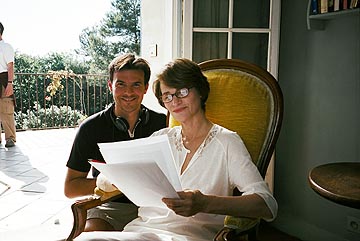
Showing posts with label Charlotte Rampling. Show all posts

18 March 2009

The Decade List: Sous le sable (2000)

Sous le sable [Under the Sand] - dir. François Ozon

The term "growing up" always comes with a hint of condescension. I try to gravitate toward the word "maturing," but isn't that just an euphemism? So for lack of better terminology, Under the Sand was the once-labeled garçon terrible of French cinema's coming-of-age. His fourth feature after a plethora of shorts (and Gouttes d'eau sur pierres brûlantes earlier that year), Under the Sand was a step forward for the director, who, with Sitcom and Les amants criminels, seemed unable to resist the fleeting charm of shock and disturbance. Pairing with actress Charlotte Rampling, whose career resurgence could be attributed single-handedly to Ozon, Under the Sand was the director's own L'avventura (though it also bares resemblance to Anthony Minghella's Truly Madly Deeply with a rigid tonal difference). Within the first twenty minutes of the film, Jean (Bruno Cremer), the husband of English literature professor Marie Drillon (Rampling), vanishes without a trace on a beach during the couple's vacation. Stricken with grief (or is it denial?), Marie returns to Paris as if nothing had happened.

Under the Sand's strength comes not only in Rampling's riveting performance but in Ozon's reluctance to diagnose Marie's condition. At a dinner party hosted by colleague and friend Amanda (Alexandra Stewart), Marie casually suggests that Amanda's husband Gérard (Pierre Vernier) should join her gym as it would convince Jean to start exercising as well. The rest of the party looks on, uncomfortably, as the subject is quickly averted. As she returns home, after being escorted by publisher Vincent (Jacques Nolot) whom Amanda is trying to set up with Marie, Jean appears in the shadows of the apartment. Was he still alive? Or was this just a figment of Marie's imagination, a way of coping? When it becomes clearer that Jean wasn't found that day at the beach, Marie's mental and emotional state becomes more disoriented. She speaks of Jean in the present tense, even correcting Vincent at a pivotal moment, but it seems that the more the audience discovers, the less Marie appears to know about what's going on in her world.

Our understanding of Marie's condition reaches a turning point after a doctor's visit, in which she's asked to settle her husband's bill as well as her own. With reservation (or is it confusion?), she asks the receptionist when his last visit was. At this point, we realize Marie isn't in a conscious state of denial, though it might have felt that way earlier when she adamantly denies recognizing one of her students who happened to be one of the lifeguards searching for her husband that summer. Things take a further turn when Marie visits her mother-in-law (Andrée Tainsy), who naively (?) suggests that Jean didn't drown and had disappeared purposefully to get away from Marie. It's the feistiest scene in the film, and it's to Ozon's credit that, like the rest of the film, the explosion comes calmly, resisting the urge to show a pair of proper ladies duking it out; he would give in fully to that urge with 8 femmes. Like Lea Massari's Anna in L'avventura, Jean is riddled with ennui, something that isn't apparent to his lover. Marie and Jean's relationship, seen in the film's early scenes, had been reduced to silence and impersonal small-talk. Marie never senses his distance, but after seeing the way she handles his disappearance, this might be a result of living in a constant state of denial.

By remaining implicit about Marie's coping, Ozon permits Rampling to brilliantly shape her character. In bouts of girlish exuberance, Rampling takes Marie through not just the stages of grief but of self-discovery. Mercifully, this isn't a film about reinventing and discovering yourself late in life, so there's a greater level of intrigue when Marie blushes at Vincent's courting and giggles uncontrollably when they start to have sex for the first time. The moments, in which Rampling returns Marie to the seemingly forgotten days of youthfulness, revive her, if only momentarily, as the dread sinks in when things become more familiar the night Jean decides to stay the night. The complex relationship between the knowledge of the viewer and of Marie wouldn't have worked without Rampling, whose beauty seems eternally preserved. Her performance keeps Under the Sand mysterious, an effort that would prove less successfully when she re-teamed with Ozon in 2003 with Swimming Pool.

Under the Sand is just one example of a common sentiment among French filmmakers in relation to the beach and les vacances. Alongside films like Catherine Breillat's Fat Girl, Sébastien Lifshitz's Presque rien, Julie Lopes-Curval's Bord de mer, Anne-Sophie Birot's Les filles ne savent pas nager and Ozon's later Le temps qui reste, the expected relation between summer and relaxation or frivolity appears to have been replaced by layers of coldness and despair (Olivier Ducastel and Jacques Martineau's Crustacés et coquillages would provide the counter to these films). I plan to address this in later posts about a few of the aforementioned films.

With: Charlotte Rampling, Bruno Cremer, Jacques Nolot, Alexandra Stewart, Andrée Tainsy, Pierre Vernier
Screenplay: Emmanuèle Bernheim, Marina de Van, François Ozon, Marcia Romano
Cinematography: Antoine Héberlé, Jeanne Lapoirie
Music: Philippe Rombi
Country of Origin: France
US Distributor: Wellspring

Premiere: 11 September 2000 (Toronto International Film Festival)
US Premiere: 4 May 2001 (New York City)

Awards: Audience Award: Best Actress - Charlotte Rampling (European Film Awards)

27 January 2009

Because pedophiles love children...

I just rewatched all of Todd Solondz's films, for better or worse, over the past week, and though I posted about his new film's cast earlier and that it was an intended sequel to Happiness, I was unaware that Forgiveness will also feature all of the same characters, played by new actors. This is what the IMDb lists:

Shirley Henderson as Joy (Jane Adams)
Ally Sheedy as Helen (Lara Flynn Boyle)
Allison Janney as Trish (Cynthia Stevenson)
Ciarán Hinds as Bill (Dylan Baker)
Michael K. Williams as Allen (Philip Seymour Hoffman) !!!
Paul Reubens as Andy (Jon Lovitz) !!!!
Renée Taylor as Mona (Louise Lasser)
Chane't Johnson as Kristina (Camryn Manheim)

It looks like Ben Gazzara's character Lenny won't be in it and that Charlotte Rampling and Gaby Hoffmann will be playing new characters (the kids are all different too, by the way) and Paris Hilton doesn't have a character name listed yet. I can only hope that Forgiveness is Happiness good and not Palindromes bad. Look for it to open at one of the big film festivals later this year, and I'll be writing more about revisiting Solondz's films later on.

11 November 2008

How'd you get to be Happiness?

Oh boy! IndieWire posted an update on Todd Solondz's new film, which is apparently a follow-up to Happiness probably in the same way Palindromes was to Welcome to the Dollhouse. The official cast includes Charlotte Rampling, Allison Janney, Michael K. Williams (aka, everyone's favorite character on The Wire, Omar), Paul Reubens (who was the first actor attactched to the project), Shirley Henderson, Ciaran Hinds and, last and certainly least, Paris Hilton. The IMDb also lists Natasha Richardson in the cast. The film should hit one of the big festivals next year.

01 January 2007

(Dis)honorable Mentions for a Worst of the Year List

I figured I won't be seeing any more shitty movies in the next coming weeks, so why not finalize a worst of the year list? Well, I'm still in the works of polishing up that bottom ten, but here are the runners-up:

Akeelah and the Bee - dir. Doug Atchison - USA - Lionsgate

Hey, gurl, how you spell shitty? Though Akeelah and her bee just missed my bottom ten list, it deserves mention for unsuccessfully trying to melt this cold, cold heart of mine.

Basic Instinct 2 - dir. Michael Caton-Jones - Germany/USA/UK - Sony Pictures

Poor Charlotte Rampling thought she was continuing her "edgy" streak with this botched abortion of a picture. Those stupid Germans put up most of the price tag for this D-grade show-pony. And, silly Sharon Stone thought we cared to see if Catherine Tramell (or, more specifically Stone's plastic surgeon) was still up to her leg-spreading, murder-fucking old ways. A little bit, way too late. The only smart thing about this fiasco was the dropping of the subtitle "Risk Addiction." Oh, did I mention that it's about as sexy as your shirtless grandfather in cut-off jean shorts eating an ice cream cone on a hot summer's day?

Cars - dir. John Lasseter, Joe Ranft - USA - Disney/Pixar

A severe blemish in Pixar's nearly untarnished reputation (though A Bug's Life is hardly one of their crowning achievements), Cars manages to not only be visually unexciting, but painfully middle-of-the-road. In a year that brought us Little Man and a sequel to Basic Instinct, Cars may not be one of the worst the year has to offer (or even Disney, for that matter, as The Wild proved to be anything but). Unquestionably though, it stands as one of the year's biggest disappointments.

Don't Tell (La bestia nel cuore) - dir. Cristina Comencini - Italy/UK/France/Spain - Lionsgate

This family-secrets pot-boiler is just another example of an Academy Award nomination for best foreign-language film not equally quality (The Crime of Padre Amaro is another good one).

Lower City (Cidade Baixa) - dir. Sérgio Machado - Brazil - Palm Pictures

When two best friends fall for the same girl, you can guess things get ugly. You may not have guessed that the conflict would be as tedious as it is in this Brazilian export. A trio of talented, attractive leads spend most of their screen time gazing blankly into the camera, having sloppy rough sex, and backstabbing one another. By about the third time the friends have come to a seemingly concrete decision about the ménage à trois only to give into their lust yet again, you'll find yourself wanting to run the characters over with a truck instead of gathering any insight about human weakness or emotions, but if hate-fucking and masochism is your thing, kindly ignore what I had to say.

Phat Girlz - dir. Nnegest Likké - USA - Fox Searchlight

Lesson learned: African men can appreciate reeeeal, full-bodied women like Miss Mo'Nique. Unfortunately, I'm not an African man. And I have something that resembles taste.

Sorry, Haters - dir. Jeff Stanzler - USA - IFC Films

Yeah, I'm sorry too. Um, why is this film nominated for a couple of Independent Spirit Awards? Did anyone actually see the film? You're better off if you haven't.

Stoned - dir. Stephen Woolley - UK - Screen Media Films

Fuck Stephen Woolley for thinking that making a shitty homage to Performance is acceptable enough for a biopic of Brian Jones.

22 December 2006

Short Cuts 22 december 2006

The Third Generation (Die Dritte Generation) - dir. Rainer Werner Fassbinder - 1979 - West Germany

Like Bruce LaBruce’s uproarious The Raspberry Reich, Fassbinder’s The Third Generation brilliantly satirizes the dealings of social terrorism. In The Raspberry Reich, our heroine, Gudrun (Susanne Sachsse) proudly proclaims, “I don’t care about what’s going on in Guatemala, Chechnya, or Cambodia; all I care about is my orgasm!” The Third Generation doesn’t exploit the chic draw to terrorism, but, like Reich, the incompetence of the folks involved. Petra (Margit Carstensen) is far more concerned with making up stories about her husband beating her to cover up for her lesbian tendencies than any real political cause. In fact, I don’t think we ever understand why our band of terrorists are even attempting to kidnap a political leader in the first place. Social terrorism is, then, reduced to the boredom of the middle-class, the desire to take phony action to justify one’s self. Though he’s rounded up a wonderful cast (Carstensen, Hanna Schygulla, Harry Baer, Bulle Ogier, Udo Kier, Eddie Constantine), I find it difficult to call The Third Generation one of Fassbinder’s finer works. It’s effectively banal (like Beware of a Holy Whore), but it’s extremely quiet for both a Fassbinder film and a film of this subject.

Jackass Number Two - dir. Jeff Tremaine - 2006 - USA

Jackass Number Two has the astounding feat of being the only film I’ve seen all year to fully, successfully accomplish exactly what it wanted. Of course, it’s ambition doesn’t exactly mirror that of The Queen or Shortbus, but it’s all a matter of relativity. The film is a reunion of sorts for the punkish daredevils (Johnny Knoxville, Steve-O, Chris Pontius, Bam Margera, etc.), set to lower the bar of bad taste and shock value (jerking off a horse, creating a rectal beer-bong, among many other perversities). These jokes and stunts would simply qualify as fatalistic debauchery if there weren’t such a joyous camaraderie involved. Seeing a bunch of grown men shaving off their pubic hair and gluing them onto a friend’s face would likely offend most people, but there’s something genuine and pure about these boys’ childlike, homoerotic gross-out vignettes. The film includes a cameo from the maestro of bad taste, John Waters (whom Knoxville befriended working on the lousy A Dirty Shame), truly putting into perspective the actions in the film. Jackass is the wet dream of a man like Waters, a bunch of goofy, scantily-clad men running around offending people and partaking in dubious life-threatening stunts, but all in the name of entertainment and friendship. There are moments of brilliance, like when Pontius turns to the camera, straight-faced, after drinking horse semen and states, “I’m really ashamed of myself right now.” That the director chose to include some notable blunders and moments like the one above exposes the surprising humanity of the film. And what’s not to love about a film that ends in a glorious musical numbers with nods to both Busby Berkley and Buster Keaton?

Heading South (Vers le sud) - dir. Laurent Cantet - 2005 - France/Canada

Laurent Canet’s fourth feature, Vers le sud, manages to be his most fascinating and complex picture, after Time Out (L‘Emploi de temps), Human Resources (Ressources humaines), and Les Sanguinaires. Starring the transcendent Charlotte Rampling as a stone-cold regular of a Haitian beach resort, the film carefully addresses tough issues: racism, classism, political upheaval, and the sexual desires related to them. The resort, headed by Albert (Lys Ambroise), serves as a hideaway for middle-aged, affluent white women to engage in their heated sexual desires for the black island boys. New to the resort is Brenda (Karen Young), a recently divorced southern woman hoping to rekindle the steaming love affair with the young Legba (Ménothy Cesar). Vers le sud is troubling in many senses, both good and bad. On a critical level, there are subplots that simply don’t work, such as a jealous rivalry between Rampling and Young, or, more specifically, don’t penetrate or provoke nearly as much as the rest of the film. Yet within the film, the counter between the intellectual, sophisticated ideas of race for these women and their searing sexual passion for these wild savage men pierces the flesh deeply. There’s no candy-coating of politically correct final revelation among any of these women, as they all seem fully conscious of the way they’re supposed to be feeling. There’s a frightening truth to all of what happens in the film’s final act as one of the locals very coldly reassures Rampling, “tourists never die here.” The women in the film never follow the logically path that an astute viewer would intellectually devise for them, as they all seem fixed in their inaccurate self-images. Vers le sud is both a flawed picture and a richly difficult one, far more potent and shrewd about its issues than most films dealing with similar subjects.

A Scanner Darkly - dir. Richard Linklater - 2006 - USA

There’s always a tug-of-war of authority when it comes to films like A Scanner Darkly, where a filmmaker with a well-recognized style and thematic approach adapts a piece of writing by someone with just as much recognizable character and method. Imagine Fellini adapting a D.H. Lawrence novel if you will. Phillip K. Dick, of course, isn’t as important of a writer as Lawrence, but you can understand the comparison. His writing style is certainly recognizable, just like Linklater’s directing. Using the painted animation that he did with Waking Life, A Scanner Darkly follows undercover cop Bob (Keanu Reeves) and his growing addiction to a drug called Substance D (think Rush, if you will). The film is set in a not-so-distant future, where a vast majority of the United States has become addicted to this dangerous drug. Linklater never overuses his animation, only occasionally imagining drug sequences where Robert Downey Jr. turns into a bug. The tug-of-war of authority never manages to hinder A Scanner Darkly, though it feels as though Dick may have won the struggle. The film feels like Linklater wearing a mask similar to that which Keanu Reeves wears inside the police offices. A Scanner Darkly occasionally addresses questions of existence, but much softer than he does in any of his other, better films. The film is more concerned with government conspiracy and double-crossings than it is of typical Linklater themes. Granted, government conspiracy may be the topic of conversation in several of his characters; it is never the focus of any of his films. A Scanner Darkly may ring up lesser-than-usual Linklater (if you aren’t counting, say, The Bad News Bears or The Newton Boys), but it never manages to become throwaway or gimmicky, which is all to the credit of the director.

11 August 2006

Red Herrings

Lemming - dir. Dominik Moll - 2005 - France

Lemming, like so many other films, was touted as one of the front-runners for the Palme d'Or the year it came out, but slowly lost steam and ended up empty-handed at the prestigious awards ceremony. Some claimed it was because Michael Haneke's Caché played the same year, and the two films similarities cancelled one another out for the top prize. However, all Lemming has in common with Caché is the pretense. Alain (Laurent Lucas) works as a successful home designer working on a system to install floating cameras in houses to detect problems when families are away. He has a beautiful young wife, Bénédicte (Charlotte Gainsbourg), and a good relationship with his boss, Richard (André Dussollier). With such a set-up, we sit in our seats waiting for the unraveling of this so-called "famille modele." The catalyst for our destruction comes in the form of Richard's cold wife Alice (Charlotte Rampling) during a dinner party, or is it in the form of a Scandinavian rodent that Alain finds in their drain pipe? Like Caché, giving away much more sort of ruins the fun and intrigue out of Lemming, even if they are of a considerable less degree than Haneke's.

Lemming, at first, is a rather hard film to decipher. It presents itself as a thriller and an analysis of the sexual politics of the upper middle class (only minus the sex). However, director Moll packs the film with potential symbolism: the lemming, the cameras, the kitchen, the boy across the street; for some reason, none of this symbolism pans out. Like his previous film With a Friend Like Harry (Harry, un ami qui vous veut du bien), Moll packs the film with underlying suspense in typical film school fashion. And like Harry, we're congratulated for our patience with a whimper. The film may be titled Lemming, but it's revealed in the end that the lemming is simply a red herring. Moll uses foreshadowing as if someone told him some hush-hush film secret right before writing the screenplay. Every little nuance in reference comes back at some point during the film, which is obnoxious in its own right, but far more annoying that most of these recurrences only reappear to the smallest degree of their potential or just exist to throw us offtrack.

Unlike Moll, Michael Haneke uses even the smallest details to reflect the bigger picture. Moll uses these small details to merely distract the viewer from the sort of secret of Lemming. My father and I saw A Perfect Murder, a wretched remake of Hitchcock's Dial M for Murder, in the theatre several years ago, and he (not an expert on film at all) could spot its text-book foreshadowing. During one scene, the director chooses to place the meat thermometer in the foreground of an establishing shot, and my dad whispered to me, "bet you can't guess what the murder weapon is going to be." Moll uses this rudimentary film technique as if he were fresh out of undergraduate film school. This may be annoying on its own, but where he really falters is in his relieving of tension. Order eventually becomes restored in typical Hitchcock fashion, but the climax is the faintest of a thud. There's something explosive and dangerous about Hitchcock even Haneke and Catherine Breillat, two directors who can satisfyingly resolve the palpable tension they create. With Moll, he uses this tension as a mask for his subtle ghost-story, one that fails to both thrill and intrigue and only succeeds as disspelling the incorrect comparisons to better films.

24 July 2006

Okay, Miss Marple

Swimming Pool - dir. François Ozon - 2003 - France/UK

In preparation for Ozon’s latest, Le Temps qui reste, I revisited Swimming Pool and recalled what my friend Brad said about the film: “it’s too clever for it’s own good.” This is certainly the case and even more so when watching the film for a second time, knowing the “surprise twist” that baffled viewers that stumbled upon Swimming Pool expecting a saucy French thriller. In knowing the twist (which I will not give away), one can see the clues Ozon laid out throughout the rest of the film, rather meticulously. Ozon’s craft is not in question here; never did I think previously that the twist was a cop-out ending. However, in looking back, it is certainly possible for someone to be too clever, a surprising thing when you realize how shockingly unclever most Hollywood films are these days. Somehow, Swimming Pool never rises above its cleverness, and, on the surface, its tarty-French-vixen-inspires-the-sexual-awakening-of-a-crusty-old-Brit storyline fails to entice.

On the other hand, Swimming Pool is rather refreshing solely for Charlotte Rampling. In her second film with Ozon (the previous being the sublime Sous le sable), she seems to have found a welcome place in French cinema, one of the few countries where established, over-forty actresses can flourish (see Isabelle Huppert and Catherine Deneuve). Unlike Sous le sable, Ozon strips away her beauty, turning her into just the school marm, sexually-repressed English bitch you’d have imagined the character to be, making us forget that in her 50s, Rampling is still really sexy. But this is to her credit, naturally, as it elevates her above simply being the hot older woman you remember from The Night Porter. Also to his credit, Ozon immerses Swimming Pool with a steaming sexuality, with Ludivine Sagnier (whom he’d worked with twice before) as the voyeuristic object of desire. Swimming Pool may be admittedly clever to the point of distraction and noticeably without the certain moxie that so characterized his earlier films, but as a well-conceived diversion, it works.