Showing posts with label Film Review. Show all posts

16 March 2014

J-C Superstar: A Review of Antony Hickling's Little Gay Boy Triptych


Little Gay Boy
2013, France
Antony Hickling

Films like Antony Hickling's Little Gay Boy aren't the sort you come across a lot these days. Technically an assembly of Hickling's short film trilogy (L’Annonciation or The Conception of a Little Gay Boy in 2011, Little Gay Boy, chrisT Is Dead in 2012 (which he directed with Amaury Grisel), and Holy Thursday (The Last Supper) in 2013), Little Gay Boy harkens back to a time when queer cinema was joyfully blasphemous, black as night, and playfully experimental in tone and look. In its own way, it continues the tradition of New Queer Cinema where filmmakers like Gregg Araki and Bruce LaBruce left off (as an aside, I was pleased to see on social media that LaBruce enjoyed the film as well). With an aptitude for defiling the sacred not unlike John Waters, the trilogy concerns a Christ-like figure named Jean-Christophe (Gaëtan Vettier), a pretty, wide-eyed young man—born from a raven-haired British hooker named Maria (Amanda Dawson)—who does for our sins and eventually meets his handsome, mustached heavenly father (played by Manuel Blanc, who winningly portrayed a similarly manipulated hustler in André Téchiné's J'embrasse pas).


And yet, unlike Waters' films, there lies an air of sadness beneath all the incest, rape, sadomasochism, and torture, which is how such dark topics are usually handled. But it's a unique blend of sadness and outrageousness, the sort Araki and LaBruce touched upon in The Doom Generation and Otto; or Up with Dead People, respectively. At heart, Jean-Christophe is simply a boy searching for connection in a cruel world that pushes him away. In the third segment, Holy Thursday (The Last Supper), Jean-Christophe leaves the merciless world to meet his estranged father in some cruise-y Garden of Eden where other religious and mythic creatures inhabit. But does he find what he’s looking for?


It certainly isn’t a stretch to put a gay spin on the story of Jesus, but it’s done effectively here. Little Gay Boy isn’t merely hollow blasphemy, like I remember Dogma being. It uses its familiar tale as the blueprint for a complex, disturbing (and rather entertaining) film about a young man’s struggle for identity and connection. Guaranteed to repel certain viewers while thrilling others at the same time, Little Gay Boy embodies that defiant queer spirit that seems to be so elusive in gay cinema today. Here's the trailer on Vimeo.

With: Gaëtan Vettier, Manuel Blanc, Amanda Dawson, Gala Besson, Biño Sauitzvy, Sothean Nhieim, François Brunet, Alvaro Lombard, Stephen Shagov, Axel Sourisseau, Christine Mingo, Hervé Joseph Lebrun, Florian David, Rémi Lange, Stéphanie Michelini

13 August 2013

Love and Death; or How to Find Yourself Crazed on the Streets of San Francisco


Blue Jasmine
2013, USA
Woody Allen

Sometime in the 1980s or possibly the early 1990s, Woody Allen shifted from being a "sure bet" to a "mixed bag." Some people might attest that the process of aging and its effects to the body and mind can account for the sort of decline we sometimes see in artists' work during their later years. I'm not sure we'll ever know what, if anything, is to blame, but somewhere after Hannah and Her Sisters, Allen's films started missing their mark; perhaps it was shortly after Allen's messy divorce with the second major muse of his career, Mia Farrow. At the rate of nearly a film per year, it's to be expected that not every one would succeed, though a few of the films (that I've seen) that came after Farrow reached the heights of his early greats (Deconstructing Harry, Vicky Cristina Barcelona, Bullets Over Broadway, possibly Mighty Aphrodite).


Allen may have seen enormous success with his 2011 outing Midnight in Paris, which awarded the filmmaker his first Academy Award in twenty-five years and went on to be the most profitable film of his career. Despite these accomplishments, Midnight in Paris brought me to make the claim that I had given up on any further projects the director had left in him. It wasn't just that I disliked the film; it made me want to go to Home Depot, buy a bunch of lightbulbs, and smash them in the parking lot. There were other things going on in my life that might have amplified the violence I felt, but my hatred was genuine. With Blue Jasmine however, the fact that I even considered seeing it was the first indication of how premature the bullheaded proclamation I made was. Blue Jasmine is almost good enough to have erased the memory of grumbling, cringing, and sighing my way through Owen Wilson's magically tedious tour of Parisian history. Almost.


The first thing about Blue Jasmine that should be mentioned—as it has been by nearly every person I know who's seen it—is its star, Cate Blanchett. As most of us are aware, she ranks among a very small list of actresses in Hollywood today who can always be counted on to be somewhere near wonderful, no matter how good or bad the film the film she's in might be. As Jasmine, née Jeanette, Blanchett's performance is the sort of thing to elicit the most enthusiastic of gay squeals. She embodies all of the things that make the gays melt in their theatre chairs. She's beautiful, unbalanced, reeling from a tragic marriage, mentally unstable, alcohol and pill dependent, viper-tongued, and oblivious to her own absurdity, all while traveling down a road that dances on the ultra-thin line that separates redemption from degradation. Oh, and she also has a really expensive wardrobe. But it's not the character alone that would make the gays extend the vowel sounds in the word "amazing" while describing the film, it's Blanchett's possession of Jasmine that makes it so outstanding.


Ostensibly an update of A Streetcar Named Desire set during our current economic crisis, the film begins with Jasmine's relocation to San Francisco to move in with her sister Ginger (a wonderful-as-usual Sally Hawkins) after losing all of her money and possessions to the government after her wealthy businessman husband (Alec Baldwin) is arrested for fraud. She's clearly on a downward spiral, but it's unclear how close to rock bottom she actually is… or if there even is a bottom to land on. It takes a while into the film before one begins to recognize the weight of the drama at hand, as Blue Jasmine isn't drenched in the sort of stark Bergman-esque tone of Interiors.


Handling the film with a light touch and taking his time to expose the severity of Jasmine's situation, Allen turns Blue Jasmine into a much darker Midnight in Paris, exploring the wounded psyche of his protagonist. He cuts between Jasmine's life in San Francisco and her life of privilege in the Hamptons, slowly unveiling the fact that what initially appear to be flashbacks are actually scenes of Jasmine's life that she's reliving and replaying. When you realize that you're seeing what's happening in Jasmine's head, you begin to see all of her fears of appearance, gossip, and other people's judgments reaffirm themselves. Though she never explicitly acknowledges these fears (looking the other way is one of her specialties), the film tells us that everyone around Jasmine knows exactly what's going on in her life and that it's a pretty hot discussion topic. An early scene where Jasmine is at the airport talking all about herself to the unlucky old woman seated next to her really struck me as the camera veers away from Jasmine at the baggage claim to capture a brief dialogue exchange between the old woman and her husband about the "strange woman" hollering goodbye to her. Throughout the film, it appears that everyone else is privy to intimate details of the sordid life of her husband, as well as Jasmine's own shaky mental state, though this too could be all in Jasmine's head. It's almost as if the truth about Jasmine's life exists everywhere but in her own delusional mind.


For anyone who has spent any time in San Francisco, Jasmine's fate at the end of the film has a sobering ring of truth to it. A friend remarked after seeing the film that he had to suspend disbelief when people on the street stop to watch Jasmine have a breakdown outside the dentist's office, because such outward displays of crazy are so commonplace in San Francisco that few would have taken much notice. Granted, it isn't every day one sees that sort of eruption from someone who looks like Cate Blanchett. I don't believe one needs to have lived in San Francisco to be haunted by the closing scene, but for those who have, it certainly provides an extra layer of bleakness to the experience. I guess Allen will never cease to be on my radar, and I'm okay with that.

Though we didn't feel the same way, I highly recommend that you read Jonathan Rosenbaum's assessment of Blue Jasmine and Allen's class obsession.

With: Cate Blanchett, Sally Hawkins, Alec Baldwin, Bobby Cannavale, Peter Sarsgaard, Louis C.K., Andrew Dice Clay, Michael Stuhlbarg, Max Casella, Alden Ehrenreich, Tammy Blanchard, Joy Carlin, Richard Conti

07 August 2013

Weathered


To Die For
1995, USA/UK
Gus Van Sant

As far as the cast is concerned, To Die For is pretty great. As the bubbly, ambitious, murderess/weather girl, Suzanne Stone, Nicole Kidman gives one of the finest performances of her wildly divergent career. I shutter to think of another major Hollywood actress who has delivered more of a range of performances and film choices than Kidman has—for better (Dogville, The Others), worse (The Stepford Wives, The Paperboy), and up for debate (Eyes Wide Shut, Moulin Rouge!). The supporting cast—particularly Illeana Douglas as Suzanne's figure skater sister-in-law and Joaquin Phoenix as one of the juvenile delinquents Suzanne hires to kill her husband (Matt Dillon)—is also uniformly wonderful. Look for a cameo of sorts by David Cronenberg near the end of the film.


In terms of satire though, it's pretty limp. I struggle to call it "dated," but its commentary on celebrity and fame has become an inescapable subject since the dawn of the Internet. Television satires like Network or The Truman Show still feel viable and relevant, even if TV has changed significantly since their release, but To Die For ultimately has very little to say that doesn't sound rather obvious nowadays. Gus Van Sant does provide some excellent touches in the film, notably the homage his makes to Howard Hawks' Scarface with two tiny X's reflecting off Suzanne's blue eyes as she delivers the weather forecast the night her husband is murdered (pictured above). To Die For almost rises to the occasion (pun sort of intended) when the U.S. National Anthem puts Suzanne into a trance as she realizes the murder of her husband doesn't just lift the weight off her "shooting star" but places it in front of more cameras than she ever dreamed. This is hardly an epiphany for anyone familiar with the current trends in "unscripted" television and tabloids, but Van Sant and Kidman's combined efforts do stand tall here, if only for a glimmering moment.

With: Nicole Kidman, Matt Dillon, Joaquin Phoenix, Casey Affleck, Illeana Douglas, Alison Folland, Dan Hedaya, Holland Taylor, Wayne Knight, Kurtwood Smith, George Segal, Susan Traylor, Maria Tucci, Tim Hopper, Michael Rispoli, Buck Henry, David Cronenberg

27 July 2013

Spoiled Leftovers


My Blueberry Nights
2007, France/Hong Kong/China
Wong Kar-wai

Though I didn't have any fond memories from my first viewing, I gave Wong Kar-wai's English-language debut My Blueberry Nights another go when I saw it airing on HBO. It was even worse than I remembered and not because of singer Norah Jones' non-presence as the film's protagonist; that was actually a welcome relief from the tedious overacting and scene-chewing from the rest of the cast, comprised of what one might consider "legitimate thespians." The film's only satisfying moment comes in an exchange between Jude Law's character and an old flame of his, played by Chan Marshall (whose music as Cat Power is featured prominently on the soundtrack), who drops by his New York City diner.


Normally, I would be quick to dismiss a scene that involves characters smoking cigarettes while talking about smoking cigarettes as a bad film school cliché, but the scene—shot mostly through the front window of the diner—is so luminous that I overlooked that bit of dialogue. Marshall's presence ignites something onscreen that both cinematographer Darius Khondji, who appears to be just imitating Christopher Doyle, and Wong Kar-wai, who appears to be imitating himself, fail to bring to life elsewhere in My Blueberry Nights. That moment makes you wish some director would give Marshall a leading role in the future, provided it isn't Wong Kar-wai.

I previously wrote about My Blueberry Nights here.

With: Norah Jones, Jude Law, David Strathairn, Natalie Portman, Rachel Weisz, Chan Marshall, Frankie Faison, Adriane Lenox, Benjamin Kanes, Michael May

04 June 2013

After the Glitter Fades


Behind the Candelabra
2013, USA
Steven Soderbergh

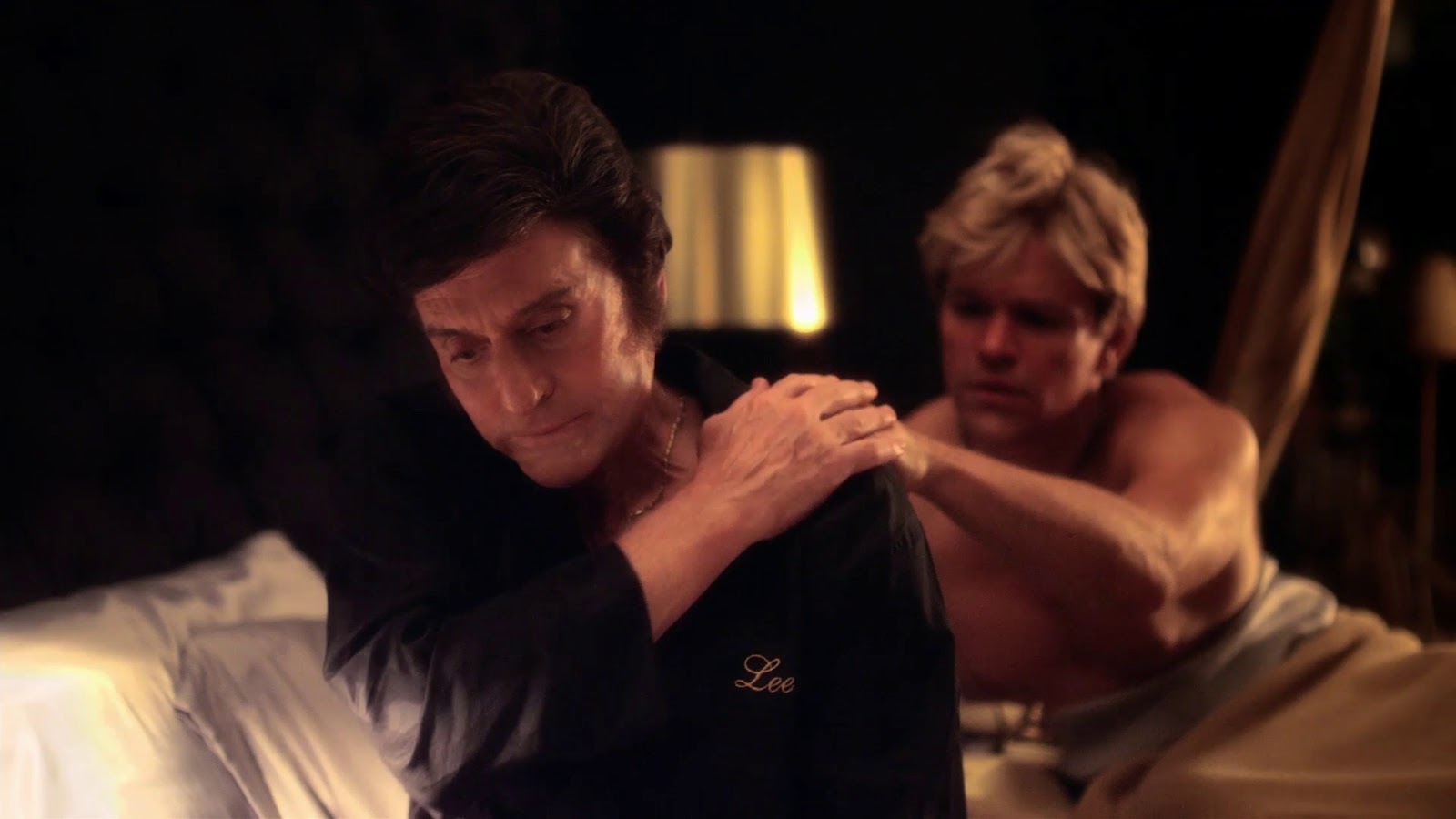
There's a lot to be said about the hype surrounding Behind the Candelabra. Reportedly, this saga of the life of famed, closeted homosexual Liberace as seen through the eyes of his boytoy is to be Steven Soderbergh's last film. The director proclaimed that Hollywood found the project to be "too gay," which is ultimately how it fell into the lap of HBO, where it aired in the USA five days after premiering in competition at the Cannes Film Festival. The movie suffered a number of delays related to star Michael Douglas's bout with cancer, and yet Behind the Candelabra persevered. The fact that it took years for a biopic no one really asked for or seemed to want in the first place to make it to the (television) screen makes its existence even more puzzling.

Why was it necessary to bring the story of Liberace to the screen? The film never gets around to answering that question. It doesn't help that most of the key players–aside from Douglas whose performance is the only remarkable and consistent thing in the film–seem to be sleepwalking through the whole thing. The screenplay, adapted by Richard LaGravenese (who happily brought you the films Freedom Writers and P.S. I Love You) from the memoir of Liberace's young lover Scott Thorson, never rises above a half-cocked marital melodrama. Matt Damon, as Thorson, coasts through the film on autopilot, which is rather unfortunate considering he's given the most time onscreen. There's an especially rough moment at the beginning of the second act, where it looks as though the costume department has shoved a pillow under Damon's shirt to try to show the audience that he had "let himself go."

But it's really the involvement of Soderbergh, who has churned out five films over the past two years (for better or worse), that confounds me. Behind the Candelabra is about the most drab, unnecessary, and mediocre swan song that I can think of. It was by sheer coincidence that I watched Gray's Anatomy, Soderbergh's visually dynamic film adaptation of Spalding Gray's exceptional monologue, just weeks prior to Candelabra. In Gray's Anatomy, Soderbergh crafts several truly breathtaking images on the screen, both during Gray's performance as well as the gorgeous black-and-white talking head interviews with ordinary people discussing their personal ocular history. What we see in Candelabra, however, is a series of awkwardly framed shots (like one where at least two thirds of the screen is taken up by crumpled brown bed sheets in the foreground as Douglas and Damon pillow talk, naked bodies perfectly concealed, in the background) and amateurishly stylized drug sequences.

It would seem useless to bother complaining about the film's sexual prudishness, its embarrassing newspaper-headline exposition about the beginning of AIDS, or the strange comic tone that never quite works (as witnessed in all of Rob Lowe's scenes), since these are just minor oversights in a project as lifeless as this one. Contracts, as it seems, needed to be met, and the rhinestones must have already been paid for... What a curious career you etched out for yourself, Mr. Soderbergh.

With: Matt Damon, Michael Douglas, Dan Aykroyd, Rob Lowe, Debbie Reynolds, Scott Bakula, Nicky Katt, Boyd Holbrook, Paul Reiser, Cheyenne Jackson, Tom Papa, Bruce Ramsay, Mike O'Malley, Jane Morris, Garrett M. Brown

04 January 2013

Acting a Fool


The Fighter
2010, USA
David O. Russell

Biopics of athletes sit about as far down on my list of filmic interests as anything I can think of at the moment, so describing David O. Russell's The Fighter as "watchable" might sound like a recommendation coming from me. The film got quite a bit of attention a year or so ago for its performances, winning Academy Awards for Christian Bale and Melissa Leo in the supporting categories. The performances failed to impress me, however, and I think this is a large scaled reflection of the essential problem I have with the film as a whole. The Fighter is competent on nearly every level one could come up with to judge it. The cinematography is nice to look at. The screenplay is solid and mostly absent of sports-biopic clichés. The sound mix is professional. The direction is engaging. The pace is consistent. The actors all act their hearts out. Competent is great for award hand-outs and ideal for thoughtless viewings on HBO while you're nursing a cold. Unfortunately though, when competent is the only thing going for a film, it almost always cancels out interesting.


By noticing the individual competency levels of those dissected elements of this insipidly-titled film, I've already lost the illusion, which is absolutely essential to a sports biopic. The film crew creates the illusion of reality in order to convey morals, lessons, truths about life and the human existence. And yet the element for which The Fighter has received the most praise and accolades is the one that causes the most harm in abating the illusion. In the four central roles, Mark Wahlberg, Christian Bale, Amy Adams, and Melissa Leo all do what they're supposed to: inhabit their characters. All four have proven themselves respectable thespians throughout their careers, but the artifice of their performances was on constant display here. There's never a moment when it isn't blindingly clear that you're watching "acting." The gold statues now on Bale and Leo's mantles don't correctly lead to the conclusion that Bale and Leo were better than Wahlberg or Adams; in fact, they seem merely indicative of the "volume" at which these actors did their job, which also seemed to have been determined by the juiciness of their respective characters' sketches.


Wahlberg's acting was easily the quietest of the quartet; I mean, there's not a lot of meat to a character who's a "nice guy" who loves his brother, his mother, and his girlfriend and simply wants to do well in his chosen career. Wahlberg wasn't nominated for an Oscar (as an actor). Adams was, considering the fact that she had a few more bells and whistles at her disposal. She donned an accent, looked "unglamorous," and played a character with a few more than Wahlberg's. Adams' character is kind of a tomboy, dropped out of college in a town where the option of such a thing is close to unheard of, admits to having a slight drinking problem that may have been the reason she stopped her education, and becomes the target of severe verbal and physical animosity from Wahlberg's seven sisters. Effectively, she lost out to Leo, who is on the highest factory setting the entire film. Her character is an overbearing mother of nine, who chain smokes, has a tacky haircut and matching wardrobe, and suffers from a bad case of denial about many things in her life, not least of which being the fact that she may not love her younger son (Wahlberg) as much as she does his older brother (Bale). In a move that's become the actor's unofficial signature, Bale literally embodies his character, dramatically altering his physical appearance in the service of his craft. And he gets the juiciest of all the characters: the golden child of a small town whose glory is in rapid decline thanks to an addiction to crack, something which slides down to negatively affect his other roles as father to a toddler and trainer to his younger brother.


The "volume" of Bale's performance – loudest of the four – unintentionally silences whatever emotional truths the film tries to reveal... what those might have been, I haven't a guess since I was too distracted by craft and didn't especially care much in the first place. The illusion vanishes, and what's left is a person pretending to have a conversation with another person using sentences that were written by yet another person, who was giving words and thoughts to a pretend version of an actual person who lived. If The Fighter had emotional truths or life lessons to be discerned from its narrative, they were spoken to these deaf ears and shown to these eyes that couldn't stop looking at the man behind the curtain... doing his job.

With: Mark Wahlberg, Christian Bale, Amy Adams, Melissa Leo, Jack McGee, Frank Renzulli, Mickey O'Keefe, Erica McDermott, Sugar Ray Leonard, Caitlin Dwyer, Alison Folland, José Antonio Rivera, Anthony Molinari

30 August 2012

Not If You Were the Last Woman in Gotham City


The Dark Knight Rises
2012, USA/UK
Christopher Nolan

There is no shortage of ways in which the conclusion to Christopher Nolan's Batman trilogy, The Dark Knight Rises, sucks. For starters, despite its disguise as a loud Hollywood action film, it's pretty boring, which is, I guess, how you can tell they were making a "serious film." This can easily be blamed on Nolan's notoriously exhausting spouts of exposition, which reached a comical level in Inception, the film he made in between The Dark Knight and his rousing. While I tend to be a bit more forgiving of the absurdity in Inception, the exposition in The Dark Knight Rises isn't used to explain complex, made-up ideas and rules that govern its film universe; it is instead used to pander to stupidity of its audience, which – judging by the lengths the screenplay requires the characters to ridiculously expel Wikipedia entries about the background of the film's villain or, worse, verbally explain the subtext of what is unfolding before them – Nolan presumes is bountiful. This however is more telling of Nolan than his audience. One could grumble about the jumbled action sequences, the over-editing, or downright silliness of most of the hand-to-hand combat, but in Nolan's defense, he's come along way since Batman Begins in that regard. But where The Dark Knight Rises, and really the entire trilogy, is most reprehensible is in its depiction of women (and lack thereof).

After Rachel, Bruce Wayne's love interest (and not much more), gets a change of actress and a "surprising," mid-film demise in The Dark Knight, Gotham City is left with a critical, though never addressed, problem: how can the city continue its legacy if its only woman has perished? Thankfully in its opening moments, The Dark Knight Rises introduces us to two additional birth canals: jewel thief Selina Kyle (Anne Hathaway) and philanthropist Miranda Tate (Marion Cotillard). Though it's very possible (I'm not totally sure) that the women never share a frame in the entire film, it becomes clear in the film's final third that the women's actions have been governing the other's for the duration of the film. This may not have been so glaring if it didn't take Nolan three films to introduce a woman who actually had things to do or if the whole trilogy wasn't so over-saturated with men.

Now with Selina Kyle, or Catwoman as we know her best, Nolan tried something I wasn't expecting. When Selina is longingly embraced by her partner-in-crime, played by Juno Temple, it appeared as if the film suggested that the feline metaphors didn't stop at "cat burglar." This is hardly an original notion, as the lesbian undertones were anything but subtle between Halle Berry and Sharon Stone in the joyless Catwoman movie, but it was something that genuinely surprised me and actually provided a deeper layer to Selina's otherwise thinly-drawn character. Like in Catwoman, this all proves to be nothing more than a tease, as this trait only aligns with Catwoman as a "bad guy," something that is forced to shift once the secret of Miranda Tate's dark identity is revealed.

I suppose Nolan assumed that since two women finally moved into Gotham City he didn't want anyone to think he was making a generalized statement about all women. After all, most of the vindictive women in Nolan's movies have a counter. In Memento, Carrie-Anne Moss has Guy Pearce's martyred wife. In Inception, Marion Cotillard, playing a character whose made-up Gallic name directly translates as "evil," has a sexless, brainiac Ellen Page. For The Dark Knight Rises, the two women keep each other in check. Just as Catwoman begins to feel bad about leading Batman to his doom, the coast is clear for Miranda to begin her nefarious plans, after "fooling" everyone with her clean energy initiative. Nolan makes the sanitization of Catwoman even more vile by ignoring the obvious hints he made to her sexuality, writing her girlfriend out of the film, and ultimately placing Batman and Catwoman in a heterosexual happily-ever-after paradise. It would be one thing if Nolan just simply didn't know how to write female characters, but he takes his inability to a whole new level of shittiness. Hey, at least all the girls of Gotham City got to make-out with the caped crusader...

With: Christian Bale, Tom Hardy, Gary Oldman, Joseph Gordon-Levitt, Anne Hathaway, Marion Cotillard, Morgan Freeman, Michael Caine, Liam Neeson, Alon Aboutboul, Ben Mendelsohn, Cillian Murphy, Nestor Carbonell, Tom Conti, Matthew Modine, Juno Temple, Daniel Sunjata, Aidan Gillen, Thomas Lennon, Robert Wisdom, William Devane, Brett Cullen, Josh Pence, Burn Gorman

10 June 2010

For the love of Jurassic Park III

Jurassic Park III
2001
USA
Dir: Joe Johnston

When it comes to Hollywood movie franchises, there always seems to be bizarre patterns of success involved. For anything starring Jason Statham, the second incarnation always stands above the others (I know this to be true of The Transporter, but I’ve heard from various, reputable folks that this is also true of Crank). For a number of the trashy horror chronicles, the Jason Statham rule also proves true (see Final Destination or Rob Zombie’s Halloween… also, outside of the horror genre, the X-Men films), but conversely there’s also the 1 and 3 rule, which applies to two of Wes Craven’s series: the original Nightmare on Elm Streets and Screams (you can argue against Scream 3 being good, certainly, but it’s hard to say it isn’t at least somewhat of an improvement over the 2nd). After indulging for the first time in the third of its series, I would contest that the Jurassic Park series (I’d say trilogy, but I’ve heard another one is in the works) falls into the 1-3 rule, though I know neither of its sequels are held in particularly high regard.

The Lost World: Jurassic Park will always be a notoriously memorable viewing experience for me or, in other words, one that marked a special turning point in my youth. The summer movie season of 1997 will be remembered best as the summer where I first recall truly loathing films of any sort, though it seems hard now to imagine that I was ever “easy to please.” The epic disappointment of The Lost World in May was quickly followed by the colossal disgust of Batman & Robin. Hollywood, for the first time I can remember, has failed this thirteen-year-old with their embarrassing sequels to films I had thoroughly enjoyed during my childhood. Needless to say (perhaps), I decided against seeing Jurassic Park III at 17, already fully jaded, expectedly angsty and unjustifiably haughty; I do know a few of my friends got really stoned and laughed their way through it, but I think I was even “too cool” to get high at that age.

The decision to watch Jurassic Park III nine years later proved to be a fortuitous one. I don’t think that sober, snotty seventeen-year-old would have been half as amused by its ridiculousness (or by the great Téa Leoni!) as this twenty-six-year-old admirer of the low-low-brow was. Like the hilarious and peculiar consistency in which Nicolas Cage has been playing characters with money troubles, Sam Neill returns to the series as Dr. Alan Grant after skipping out on The Lost World and gets tricked into returning to the dinosaur-infested island by a couple of zeroes and a dollar sign (well, as he points out at some point in the film, it’s a neighboring island from the one in the first film, one that’s become overtaken by wild dinosaurs). He’s tricked by a bumbling pair of loons–played by William H. Macy and Téa Leoni (whose hair was clearly styled by the world’s most dedicated Chynna Phillips fan)–whose son (Trevor Morgan) has gone missing on the island after a hang-gliding disaster with the teacher who fucks Reese Witherspoon in Election, who I believe is supposed to be Leoni’s new husband but looks convincingly enough like the town pederast. That the guy from Election shows up, not to mention Laura Dern in a thankless cameo, makes sense when you see Alexander Payne and Jim Taylor’s names appear in the end credits as co-writers. Unlike a lot of other writer-for-hire jobs, Payne and Taylor’s involvement isn’t mysterious or lost in translation, as their contribution can be seen entirely in Macy and Leoni’s characters, who appear to have been magically transported from a very different movie about goofy, bickering exes who inevitably fall back in love with each other. (In a perfect world, Dern would have reprised her role as Ruth Stoops instead of Dr. Ellie Sattler and been cosmically transported into Jurassic Park III).

All of the big dinosaur attacks, once Neill lands on the island with his protégé Alessandro Nivola and the Macy/Leoni odd couple, resemble little of what happens in the first two films, as new director Joe Johnston (the man responsible for such gems as Honey, I Shrunk the Kids, The Rocketeer, The Pagemaster, Jumanji and most recently The Wolfman) shows more of an affinity for the Turok video games than the filmmaker he’d worked under for years. As is always the case for sequels, the stakes are higher, which here translates as the black guy getting offed earlier than he usually would (it takes a little longer for Michael Jeter to bite it). Of course, Macy and Leoni’s far-fetched-in-the-real-world but sure-to-be-true-in-the-movie-land notion that their child is still alive proves true, and of course, the kid is magnetically drawn to the otherwise misanthropic Dr. Grant… and thankfully isn’t half as irritating as the two writer’s contrivances that pass as Richard Attenborough’s grandchildren in the first film (the children of neurotic parents always turn out a lot saner than usual in movies, don’t they?).

At just ninety minutes, Jurassic Park III’s climax smells like the trenchant cocktail of screenplay revisions and budget-cuts, but that’s hardly a setback. Jurassic Park III provides more entertainment than it ever should have; placing a bunch of respectable actors in the broken back half of a jet that’s being tossed around and smashed by a dinosaur has never been a bad idea in my mind, and when those actors happen to be a desperate Sam Neill, a hot Alessandro Nivola, a mustache-donning William H. Macy and Téa Leoni (no adjective needed), I’m sold.

All three Jurassic Park films are available on DVD from Universal everywhere; Blu-rays have yet to come out for any of them.

01 June 2010

Down... on the Ground

This post was intended to analyze the similarities and differences between Up in the Air, Fish Tank and An Education, but unfortunately it proved to be a rather uninteresting exercise in surface observations and difficult prose. So I scrapped the idea, but salvaged the only thing worth taking from it: my disdain for Up in the Air. So apologies for the jumpiness and inconclusive arguments, but I thought it might be of some interest regardless. For those who haven't seen the films, I wouldn't recommend reading as this is infested with “spoilers.”

As we’re nearing the half-way point in 2010, I took a look back at what few ’09 releases I actually saw, and one trend really stood out: marital and parental escapism. In three of the notable award contenders of 2009—Jason Reitman’s Up in the Air, Andrea Arnold’s Fish Tank and Lone Scherfig’s An Education—the very same third act revelation appears as the protagonists make an uninvited visit to the homes of their respective lovers, discovering that their romantic flames are not only frauds, but frauds with spouses and children.

For Up in the Air’s Ryan Bingham (George Clooney), a man whose views of romance are mirrored (of course) by his on-the-go career which keeps him in transit for the majority of his time, a hotel bar encounter with a woman like Alex Goran (Vera Farmiga) leads to the most ideal of no-strings-attached affairs. Alex is a woman, seemingly, like Ryan: professional, mature, horny and uninterested in anything related to our traditional notions of maintaining a romantic relationship with someone. Through several different scenarios where Ryan is forced to interact with people whose notions of relationship stability greatly differ from his own, he undergoes a change of heart and falls for Alex in a way he’s likely never felt for anyone else.

In an attempt to compare/contrast An Education and Fish Tank, I hit a dead end, as they’re almost too similar. Both feature teenage girls as protagonists, their older love interests (Peter Sarsgaard, Michael Fassbender) are deceptively charming and both films happen to be directed by women. The only thing truly dividing them from a narrative perspective is their place in time and the issue of class. An Education’s Jenny (Carey Mulligan) comes from a typical middle class English family in the early 1960s, while Fish Tank’s Mia (Katie Jarvis) lives in the outskirts with her young, hot, single mother (Kierston Wareing) and little sister (Rebecca Griffiths). Their differences in quality, which is a steep one, can best be chalked up to the flatness and dryness of Scherfig’s images against the vividness and vibrancy of Arnold’s.

With surprising consistency, Jenny, Mia and Ryan’s worlds are all crushed through uninvited visits to their respective lovers’ homes. It was, after all, too good to be true for each of them, but the lessons aren’t all the same. For Up in the Air, Alex’s “other life” becomes just one of the film’s infuriatingly heavy-handed views of the traditional family structure. Alex is not only villainized through the revelation but all of the refreshing qualities that Ryan found in her morph into the traits of an unhappy wife and mother acting out. While it seemed relatively clear that Ryan’s young co-worker/traveling companion Natalie Keener’s (Anna Kendrick) function in the film was to give (false) validation to Ryan’s beliefs, Natalie’s purpose changes when the film places its scarlet letter upon Alex, as she starts to work as a defense for the screenwriters (and novelist, I suppose, though I haven’t read the book) in showing us that all women aren’t cruel, manipulative, heart-stomping adulteresses. It’s hard to determine whether the simple, vile justification of Alex’s away-from-home behavior or the nauseating placement of the interview footage of the real people laid off from their jobs where they all emphasize the importance of family is what ultimately destroys Up in the Air, but both elements certainly succeed in ridiculing the protagonist… or maybe we should have never trusted a filmmaker who tried to garner sympathy for a character who crushes other people’s lives as a trade.

All three films are available on Blu-ray and DVD in the UK. Up in the Air and An Education are available on Blu-ray and DVD in the US, and Fish Tank will be released by Criterion later in the year.

26 April 2010

Rise Above

The Girl on the Train
La fille du RER

2009, France
André Téchiné

When Kelly Reichardt’s Wendy and Lucy came out, many people found it to be a rather telling portrait of the economic crash of 2008, though many others noted that the film was made (and even premiered) before that had happened. What was fascinating though about the label placed upon it was that the film concerned a woman in her mid-20s, played by Michelle Williams, while the media focused on those individuals who were being laid off from jobs they’d had for years. André Téchiné’s latest film, The Girl on the Train, is one of the first films to really address this age group, the students who graduated at a time when the work field was grim to say the least, with that in mind… though what’s most appealing about the film is that it never directly approaches the subject.

Twentysomething Jeanne (Émilie Dequenne) is a charming, naïve young woman who lives with her mother Louise (Catherine Deneuve) and spends most of her afternoons rollerblading through Paris. The first moment we see Louise, she’s sitting in front of a computer, looking online for jobs to which her daughter could apply. The scene comes across as rather benign, trivial moment within the film. Louise nags her daughter about finding a job, Jeanne agrees with her while trying to change the subject, Louise adds that the particular job she’s found is working for someone she used to know and offers to revise Jeanne’s résumé. At first, the scene appears to exist in order to establish the relationship between the mother and daughter, who otherwise carry on like the best of friends, but it also establishes a generational gap and places context for the film’s driving act, midway through the film.

For a filmmaker approaching 70, Téchiné has a rather astounding grasp of what it means to be young in this economy. Jeanne lives comfortably with her mother and finds distraction with her iPod and rollerblades, while still harboring a hint of shame about her unemployment, as she lies to Franck (Nicolas Duvauchelle), the boy who fancies her, about working at the job for which she interviewed and (evidently) didn’t get. The other significant youth in the film is the grandson of Samuel Bleistein (Michel Blanc), the lawyer whose secretarial position Jeanne applied for. Nathan’s (Jérémy Quaegebeur) situation is a bit different. He’s 13, approaching his bar mitzvah and consistently bossed around by his quarrelling, liberal parents (Ronit Elkabetz and Mathieu Demy) even though they happen to think their actions are in sync with their son’s wishes. Despite the age difference between Jeanne and Nathan, he’s the only one who seems to understand her situation, or at least the only one willing to lend an ear without imposing judgment upon her, another example of the miscommunications between generation.

On a purely superficial level, Téchiné cinematically captures personal exchanges via the Internet in a totally magnificent, compelling way. One of the biggest hurdles filmmakers have had to tackle in recent years is how to make an online conversation visually stimulating, and it’s an obstacle at which most have failed. Favoring online video chat over phone calls, Jeanne and Franck communicate with one another as most kids would, and without a word spoken, Téchiné manages to make their exchanges as dynamic, sexy and engaging as if they were talking back and forth in person. He even adds a surprising touch with Jeanne and Franck’s first sexual experience together happening through the video chat, which could be chalked up to avoiding the interference from Jeanne’s mother or Franck’s roommate or the comfort Jeanne feels through the impersonal medium, avoiding the likely awkwardness of first having sex with someone (or both, naturally).

Jeanne’s situation, the one that only Nathan is able to understand, is not the pangs of being young but specifically the film’s central act in which Jeanne lies to the police claiming to have been a victim of an anti-Semitic attack. Jeanne isn’t Jewish, but she’s living in a world (the film world, that is; I’m not sure whether this is true in the real one or not) where anti-Semitic attacks are on the rise. Her recognition of this fact is probably brought upon through Bleistein, a Jew who’s gained media attention for defending the victims in court. Téchiné spends a great deal of time building up to Jeanne’s act, diving the film into two chapters, “Les circonstances” (Circumstances) and “Les consequences” (Consequences). No single moment, even the apparent one, gives explanation to why Jeanne did what she did. It’s best understood as a product of realities of her life (obviously) and her struggle not to disappear. Jeanne’s entire relationship with Franck provides the biggest clue to this. On most levels, Franck doesn’t seem like the sort of guy Jeanne would normally be attracted to. He’s rough, streetwise and has a family history of crime… not to mention that Louise seems to disapprove of him (which may be one of his appeals, I’m not sure). What Jeanne finds appealing in Franck is the attention he gives her; he appears dedicated and loyal to her, even if he’s rather shady and manipulative otherwise.

Jeanne never really gives a reason for what she did, and it’s very possible that she isn’t even aware of it in the first place. She doesn’t appear to be a racist toward Jews or the North Africans she claimed attacked her. She seems oblivious to a lot of things, including her own motives. The choice of casting Dequenne as Jeanne doesn’t seem to be an accident. Jeanne shares quite a few similarities with the title character in Rosetta, the role Dequenne is famous for. Both young women feel the weight of the economy crushing them, and both have unorthodox (and morally grey) ways of surviving through it. While Rosetta’s situation is one of singularity, Jeanne’s however is a sentiment that’s, unfortunately, considerably widespread.

La fille du RER will hit DVD from Strand Releasing in the US on 18 May; it is already on DVD in Canada (from Mongrel Media) and France (from UGC Vidéo) and will be released theatrically in the UK in June.

27 November 2009

Humpin' Around

Precious: Based on the Novel Push by Sapphire - d. Lee Daniels - 2009 - USA - Lionsgate

There's so little time left in the year for me to spend a whole lot of time writing about films that I don't like, but I need to flush my feelings for Lee Daniels' Precious out in some form. When my friend Tom sent me a Netflix note saying, "God help me, I partially agree with Armond White," I couldn't help but share his sentiment. Despite the editorial errors (really, how does giving the wrong title for a director's previous film, Shadowboxer not Shadowboxing, get past the NY Press' editor?) and including Marci X, Little Man, Mr. 3000 and Norbit (!!) in all seriousness as "excellent recent films with black themes," White sort of nails the self-loathing that runs through all of Precious, from its ludicrous fantasy sequences--the worst of which placing Precious (Gabourney Sidibe) and her mother (Mo'Nique) in a scene from Vittorio De Sica's Two Women as they watch it on television, despite the fact that Precious is barely literate--to its onslaught of racial stereotypes.

I am glad, however, that Lee Daniels' incompetence is finally getting some press after the film screened at the New York Film Festival. No one seemed to have a bad word to say about it at Sundance, Cannes or Toronto. Poverty porn, emotional porn, a new kind of blaxploitation, an impeccably acted piece of trash, a con job -- all of these descriptions are appropriate. One of the highlights of White's review points out one of Daniels' unsubtle, messy visual gimmicks: "The scene where Precious carries her baby past a “Spay and Neuter Your Pets” sign is sick." But I can't help but give it up, as most of the film's detractors other than White seem to be doing, to the actors, from newcomer Sidibe, a monstrous, Joan Crawford-on-welfare Mo'Nique, a make-up-less, ratty-wig-donning, Jersey-accented Mariah Carey and Paula Patton as the light-skinned lesbian teacher/saint who looks after Precious. Whether the actresses' collectively marvelous performances add to Daniels' lunacy or rise above it isn't certain... all I know is that, thanks to its audacity, if Precious does manage to take home the Best Picture Oscar next February, I won't moaning as much as I did when that other overblown race-issue melodrama did a few years back.

02 July 2009

Staying Alive?

Tony Manero - dir. Pablo Larraín - 2008 - Chile/Brazil - Lorber HT Digital

Written for Gone Cinema Poaching.

Like Taxi Driver and Man Bites Dog, Pablo Larraín's Tony Manero offers a new addition to the league of cinema's most fascinatingly maladaptive sociopaths with Raúl Peralta (Alfredo Castro). Set in Chile during Pinochet's oppressive reign over the country, Larraín takes an unflinching look at his nation's history through Raúl, who'd rather be referred to as Tony Manero after John Travolta's character in Saturday Night Fever. While bearing some resemblance to Harmony Korine's Mister Lonely, the two films part ways quickly as Raúl's celebrity projection turns rapidly grim when we discover that he also brutally murders innocent people without a glimpse of reservation.

More than Taxi Driver, to which it shares a political leaning, Tony Manero recalls some of Michael Haneke's notable works. Like a hybrid of Funny Games' Paul (Arno Frisch) and The Piano Teacher's Erika (Isabelle Huppert), Raúl incorporates Erika's appalling acts of sadism with Paul's absence of remorse. He's not inhuman as much as he's beyond it, a product of the devastating reality of his world and Hollywood's endless dream-pushing.

I resist calling Tony Manero a satire or even a dark comedy as, like The Piano Teacher, its moments of rabid cruelty only spark laughter as a relief from the unshakeable dread the film creates and the repugnance that it instills. In one of the film's most memorably ghastly scenes, the local theatre's change of attraction from Saturday Night Fever to another Travolta vehicle Grease propels Raúl to crush the elderly projectionist's skull inside the projection booth.

While the underlying idea in Tony Manero rings familiar on a couple of levels, those associations never infiltrate the hypnosis Larraín and Castro, who co-wrote the screenplay, place the audience under. Whether it's mortification or a seedy desire to where the film could possibly be headed, there's something thoroughly transfixing about Tony Manero, which sustains its foreboding uneasiness to its final, astonishing sequence.

22 June 2009

Family Ties

Summer Hours [L'heure d'été] - dir. Olivier Assayas - 2008 - France - IFC Films

Written for Gone Cinema Poaching.

Separating Olivier Assayas' films into two camps, the "globe-trotting erotic-thriller" and the "prestige" pic, is an easy action. On a superficial level, Boarding Gate and Summer Hours couldn't be more different. However, when it comes to Assayas' work, most people choose to make the simple connections, such as the one above or noting the similarities between demonlover and Boarding Gate without recognizing their strong dissimilarities. But really, pairing one against the other overlooks the central idea that appears in nearly his entire body of work (I haven't seen any of the films that came before L'eau froide): a search for identity within changing landscapes, even if it's indirect.

In Summer Hours, the search is quite apparent. After the passing of their mother Hélène (Edith Scob), three siblings (Charles Berling, Juliette Binoche, Jérémie Renier) must determine how to deal with their family's inheritance, with special consideration for the fact that each of them live on separate continents. Like really all of the director's films, Summer Hours is almost deceptively slight. Assayas keeps the film free of teary melodrama and unwanted sentimentality, restricting his camera from the actual death of Hélène as well as her funeral. Summer Hours isn't about a family's grief; it's about the value, monetary and sentimental, of what's left behind.

Though its persistent honesty is no small feat, the strength of the film reveals itself fully in its final moments. Once it's decided to sell the family home, the two eldest grandchildren (Alice de Lencquesaing, Emile Berling) throw a party in the nearly empty house. As teenagers and loud music occupy the rooms, Assayas takes the film in a place I never expected, though maybe I should have known better as he's always placed great emphasis on his films' closing scenes, even if they seem initially puzzling. As my hands down choice for the best film to hit theatres this year, I'd be surprised to find a film as sublime as Summer Hours in the remaining months of 2009.