13 August 2013

Creating Your Own Picture Story in Art Trash


Tropic of Cancer
(Al tropico del cancro)
1972, Italy
Giampaolo Lomi, Edoardo Mulargia

Often times, when I'm working from home, I throw something on the television to half-watch, depending on the task. Upon the recommendation of a horror aficionado friend of mine, I decided upon a giallo film called Tropic of Cancer (Al tropic del cancro)—no relation, as far as I could tell, to the Henry Miller novel—and marveled at what I saw. Mind you, I was listening to music on my headphones and fiddling on the Internet at the same time. With no knowledge of what was supposed to be transpiring in the film (and, most importantly, no desire to find out), I was hypnotized by its vulgar beauty. With a bit of creative invention on a few of the details, some of the highlights of Tropic of Cancer are the following: exquisitely arranged dream/fantasy sequences in which a fake-breasted blonde, vaguely resembling Linda Evans, runs slow-motion through a red hallway (in the direction of the sexy, hair-tosselling fan on set, it would seem) while naked black men reach out to grab her (her perfect hammy/beautiful look of terror is utilized several times in the film with Mario Bava-esque zooms); a curly-haired, baby-faced Porky the Pig döppelganger–fey in the sort of way that was befitting of villains in cinema once upon a time–getting a massage from his virile, young, native servant while a white teenage boy sheds his towel to dive into a pool filled of giant blocks of ice, cut against shots of two gorgeous agitated peacocks; a mustached Jack Palace lookalike wearing a see-through blouse getting Nancy Kerrigan-ed by The Invisible Woman while sitting on a deckchair; a strange macho rivalry between two hunky Italian men that are barely distinguishable from one another (intentional? I'm not sure), trying to win the affections of the fake-breasted white lady, spying on one another making passionate love to her; frenzied native dances that turn into frenzied native orgies as the white folk look on; the bizarre murderous ends for both Porky the Pig, speared in the mud like a swine, and Jack Palance, face burned off in a mine; and a voodoo spiritual involving a woman I imagine to be the wild voodoo priestess holding a giant bucket over her head while the natives dance around a naked couple in shackles in either a wedding ceremony or a murder ritual. Do these sort of art trash films get made any more? If so, where? And if not, what has replaced them? There's a void in the world of cinema when art and trash have to exist separately. I feel it would only spoil the fun I had by actually watching the film, so I put together a photo series for Giampaolo Lomi and Edoardo Mulargia's Tropic of Cancer for your viewing pleasure.

With: Anthony Steffen, Anita Strindberg, Gabriele Tinti, Umberto Raho, Stelio Candelli, Gordon Felio, Kathryn Witt, Alfio Nicolosi, Bob Lemoine, Pierre Richard Merceron, Fred Ade


Love and Death; or How to Find Yourself Crazed on the Streets of San Francisco


Blue Jasmine
2013, USA
Woody Allen

Sometime in the 1980s or possibly the early 1990s, Woody Allen shifted from being a "sure bet" to a "mixed bag." Some people might attest that the process of aging and its effects to the body and mind can account for the sort of decline we sometimes see in artists' work during their later years. I'm not sure we'll ever know what, if anything, is to blame, but somewhere after Hannah and Her Sisters, Allen's films started missing their mark; perhaps it was shortly after Allen's messy divorce with the second major muse of his career, Mia Farrow. At the rate of nearly a film per year, it's to be expected that not every one would succeed, though a few of the films (that I've seen) that came after Farrow reached the heights of his early greats (Deconstructing Harry, Vicky Cristina Barcelona, Bullets Over Broadway, possibly Mighty Aphrodite).


Allen may have seen enormous success with his 2011 outing Midnight in Paris, which awarded the filmmaker his first Academy Award in twenty-five years and went on to be the most profitable film of his career. Despite these accomplishments, Midnight in Paris brought me to make the claim that I had given up on any further projects the director had left in him. It wasn't just that I disliked the film; it made me want to go to Home Depot, buy a bunch of lightbulbs, and smash them in the parking lot. There were other things going on in my life that might have amplified the violence I felt, but my hatred was genuine. With Blue Jasmine however, the fact that I even considered seeing it was the first indication of how premature the bullheaded proclamation I made was. Blue Jasmine is almost good enough to have erased the memory of grumbling, cringing, and sighing my way through Owen Wilson's magically tedious tour of Parisian history. Almost.


The first thing about Blue Jasmine that should be mentioned—as it has been by nearly every person I know who's seen it—is its star, Cate Blanchett. As most of us are aware, she ranks among a very small list of actresses in Hollywood today who can always be counted on to be somewhere near wonderful, no matter how good or bad the film the film she's in might be. As Jasmine, née Jeanette, Blanchett's performance is the sort of thing to elicit the most enthusiastic of gay squeals. She embodies all of the things that make the gays melt in their theatre chairs. She's beautiful, unbalanced, reeling from a tragic marriage, mentally unstable, alcohol and pill dependent, viper-tongued, and oblivious to her own absurdity, all while traveling down a road that dances on the ultra-thin line that separates redemption from degradation. Oh, and she also has a really expensive wardrobe. But it's not the character alone that would make the gays extend the vowel sounds in the word "amazing" while describing the film, it's Blanchett's possession of Jasmine that makes it so outstanding.


Ostensibly an update of A Streetcar Named Desire set during our current economic crisis, the film begins with Jasmine's relocation to San Francisco to move in with her sister Ginger (a wonderful-as-usual Sally Hawkins) after losing all of her money and possessions to the government after her wealthy businessman husband (Alec Baldwin) is arrested for fraud. She's clearly on a downward spiral, but it's unclear how close to rock bottom she actually is… or if there even is a bottom to land on. It takes a while into the film before one begins to recognize the weight of the drama at hand, as Blue Jasmine isn't drenched in the sort of stark Bergman-esque tone of Interiors.


Handling the film with a light touch and taking his time to expose the severity of Jasmine's situation, Allen turns Blue Jasmine into a much darker Midnight in Paris, exploring the wounded psyche of his protagonist. He cuts between Jasmine's life in San Francisco and her life of privilege in the Hamptons, slowly unveiling the fact that what initially appear to be flashbacks are actually scenes of Jasmine's life that she's reliving and replaying. When you realize that you're seeing what's happening in Jasmine's head, you begin to see all of her fears of appearance, gossip, and other people's judgments reaffirm themselves. Though she never explicitly acknowledges these fears (looking the other way is one of her specialties), the film tells us that everyone around Jasmine knows exactly what's going on in her life and that it's a pretty hot discussion topic. An early scene where Jasmine is at the airport talking all about herself to the unlucky old woman seated next to her really struck me as the camera veers away from Jasmine at the baggage claim to capture a brief dialogue exchange between the old woman and her husband about the "strange woman" hollering goodbye to her. Throughout the film, it appears that everyone else is privy to intimate details of the sordid life of her husband, as well as Jasmine's own shaky mental state, though this too could be all in Jasmine's head. It's almost as if the truth about Jasmine's life exists everywhere but in her own delusional mind.


For anyone who has spent any time in San Francisco, Jasmine's fate at the end of the film has a sobering ring of truth to it. A friend remarked after seeing the film that he had to suspend disbelief when people on the street stop to watch Jasmine have a breakdown outside the dentist's office, because such outward displays of crazy are so commonplace in San Francisco that few would have taken much notice. Granted, it isn't every day one sees that sort of eruption from someone who looks like Cate Blanchett. I don't believe one needs to have lived in San Francisco to be haunted by the closing scene, but for those who have, it certainly provides an extra layer of bleakness to the experience. I guess Allen will never cease to be on my radar, and I'm okay with that.

Though we didn't feel the same way, I highly recommend that you read Jonathan Rosenbaum's assessment of Blue Jasmine and Allen's class obsession.

With: Cate Blanchett, Sally Hawkins, Alec Baldwin, Bobby Cannavale, Peter Sarsgaard, Louis C.K., Andrew Dice Clay, Michael Stuhlbarg, Max Casella, Alden Ehrenreich, Tammy Blanchard, Joy Carlin, Richard Conti

10 August 2013

A Guide to the 66th Locarno International Film Festival, 2013


After a short two month break following Cannes, the major film festival season begun again this week with the 66th Locarno Film Festival, which is the first in a quick succession of major premiere festivals in the autumn of each year followed closely by San Sebastián, Venice, and Toronto chronologically. In addition to those top tier festivals, there are a handful of other notable premiere fests that will be starting soon, including the Festival des Films du Monde in Montréal, the Tokyo International Film Festival, and the Torino Film Festival. Locarno opened with the latest Hollywood crime film from Icelandic director Baltasar Kormákur, 2 Guns, with Mark Wahlberg and Denzel Washington.


There are two main competitions that take place at Locarno: the Concorso Internazionale (International Competition) and the Concorso Cineasti del Presente ("Filmmakers of the Present" Competition for emerging filmmakers). Last year, the top prize of the Concorso Internazionale, the Golden Leopard, went to a surprise choice, Jean-Claude Brisseau's La fille de nulle part (The Girl from Nowhere). Pedro González-Rubio (Alamar) won the Golden Leopard in the Cineasti del Presente section with his documentary/narrative Inori. This year, the Concorso Internazionale features a mix of films from some major figures in Asian cinema as well as a few burgeoning auteurs.


You can access the full line-up for the Concorso Internazionale through Locarno's website, as I'm trying to steer clear of unnecessary list-making these days. The competition features the latest work from Shinji Aoyama (Eureka), Joanna Hogg (Unrelated), Hélène Cattet & Bruno Forzani (Amer), Albert Serra (Birdsong), Thomas Imbach (I Was a Swiss Banker), Kiyoshi Kurosawa (Tokyo Sonata), Júlio Bressane (Killed the Family and Went to the Movies), Emmanuel Mouret (Shall We Kiss?), Guillaume Brac (A World Without Women), Daniel & Diego Vega (October), David Wnendt (Combat Girls), Chang Tso-chi (When Love Comes), Pippo Delbono (La paura), Yervant Gianikian & Angela Ricci Lucci (Oh! Uomo), Joaquim Pinto (Twin Flames), Yves Yersin (Les petites fugues), and Hong Sang-soo, who will be presenting his second film of 2013 at the festival after Nobody's Daughter Hae-Won played in competition at the Berlinale. The only American film competing this year is Destin Cretton's Short Term 12, an expansion of his Sundance prize-winning 2008 short of the same name; Short Term 12 won the Grand Jury Prize and Audience Award at this year's SXSW Film Festival.


While several of the competition films have piqued my interest, there are two that top my list: Corneliu Porumboiu's When Evening Falls on Bucharest or Metabolism (Când se lasă seara peste Bucureşti sau metabolism) and Claire Simon's Gare du Nord. When Evening Falls on Bucharest or Metabolism is writer/director Porumboiu's first film following the international acclaim of Police, Adjective (Poliţist, adjective) in 2009—though he did co-write the screenplay with director Igor Cobileanski for The Unsaved (La limita de jos a cerului), which played in the East of the West Competition at the Karlovy Vary International Film Festival this past summer. Porumboiu's latest follows the exploits of a movie director (played by Bogdan Dumitrache, who won the Best Actor prize for the film The Best Intentions at Locarno in 2011) whose affair with one the actresses begins to disrupt the film shoot. In Gare du Nord, four strangers–played by Nicole Garcia, Reda Kateb (A Prophet), François Damiens (The Wolberg Family), and Monia Chokri (Heartbeats)–find casual encounters in the famous Parisian train station. The extensive ensemble cast also includes my biggest crush of the year, Christophe Paou from Alain Guiraudie's Stranger by the Lake (L'innconu du lac), Lou Castel, Samir Guesmi, Jean-Christophe Bouvet, André Marcon, Ophélia Kolb, and Jacques Nolot. Simon's sadly overlooked previous film, God's Offices (Les bureaux de Dieu), also utilized an enormous cast (including Emmanuel Mouret, whose new film is also in competition) in a single location, with Garcia again at the center of the picture. Additionally, Simon also has a documentary called Human Geography (Géographie humaine) screening at the festival out of competition that almost sounds like a non-fiction version of Gare du Nord.


As I don't have much to reference regarding the Concorso Cineasti del Presente, I'll instead focus on some of the other notable films playing and/or premiering at Locarno this year. Following winning turns in Xavier Dolan's Heartbeats (Les amours imaginaires) and Laurence Anyways, Canadian actress Monia Chokri, who can be seen in Gare du Nord, makes her directorial debut with the short An Extraordinary Person (Quelqu'un d'extraordinaire), which co-stars another Dolan regular, Anne Dorval. In the Piazza Grande section, you'll find the latest comedy from director Sam Garbarski (Irina Palm), Vijay and I, which stars Moritz Bleibtreu, Patricia Arquette, Michael Imperioli, Moni Moshonov, and Hanna Schygulla; cult French filmmaker Quentin Dupieux's black comedy Wrong Cops, which re-teams Laura Palmer's parents Grace Zabriskie and Ray Wise alongside Marilyn Manson, Eric Wareheim, and Jack Plotnick; a May-December Parisian romance between Michael Caine and Clémence Poésy in Sandra Nettelbeck's Mr. Morgan's Last Love, which also stars Gillian Anderson, Jane Alexander, and Justin Kirk; Jeremy Saulnier's acclaimed thriller Blue Ruin, which won the FIPRESCI Prize for the Quinzaine des Réalisateurs at Cannes this year; Sebastián Leilo's Gloria, the Best Actress winner (Paulina García) at this year's Berlinale, which will be playing soon at both the San Sebastián and Toronto Film Festivals; and the latest film from Swiss director Lionel Baier (Garçon stupide), Longwave (Les grandes ondes (à l'ouest)), a road movie/comedy with Valérie Donzelli and Michel Vuillermoz.


Two new shorts from directors João Pedro Rodrigues and João Rui Guerra da Mata, Mahjong and The King's Body (O Corpo de Afonso), will screen at the festival. The directors' previous feature The Last Time I Saw Macao (A Última Vez Que Vi Macau) played in the Concorso Internazionale last year. An experimental documentary co-directed by acclaimed filmmakers Ben Russell and Ben Rivers, A Spell to Ward Off the Darkness, will also play out of competition, alongside Que d'amour, the new film by director Valérie Donzelli, and How to Disappear Completely, the latest from Philippine director Raya Martin. In a special section highlighting the work some of the festival's jury members work, there will be a screening of the president of the Concorso Internazionale jury Lav Diaz's film Norte, the End of History, which played at in the Un Certain Regard section at Cannes earlier this year. There will also be a complete retrospective of the films of George Cukor at the festival, and it's always worth taking a look at their annual Open Doors section, which assists filmmakers in nations where funding can be difficult, as well as showing a selection of films from the particular region. This year, the focus is on the Southern Caucasus, highlighting films from Armenia, Azerbaijan, and Georgia. Expect some more festival guides to pop up on the blog over the next two months.

09 August 2013

Voluptuous Horror: RIP Karen Black


The world lost one of its shining stars yesterday, as legendary actress Karen Black died following a long battle with cancer. An actress with a look that was just as striking as her presence, Black saw her career take off at the very beginning of the 1970s after co-starring in Dennis Hopper's iconic Easy Rider and Bob Rafelson's stunning Five Easy Pieces, which garnered the actress an Academy Award nomination as well as the first of her two Golden Globes wins. Her other Golden Globe win came four years later for Jack Clayton's adaptation of The Great Gatsby, in which she played Myrtle Wilson. The '70s were a particularly lucrative decade for Black, who also appeared in Jack Nicholson's directorial debut Drive, He Said, John Schlesinger's The Day of the Locust, Robert Altman's Nashville, Dan Curtis' Burnt Offerings (as well as Curtis' cult TV movie, Trilogy of Terror), Alfred Hitchcock's Family Plot (his final film), Jack Smight's Airport 1975, and Peter Hyams' Capricorn One.


Black brought her talents as a stage actress to the screen as well, reprising her role in Altman's film adaptation of Ed Graczyk's play Come Back to the Five and Dime, Jimmy Dean, Jimmy Dean, alongside her Broadway co-stars Cher and Sandy Dennis. From the 1980s on, Black's film career comprised of a number of cultish oddities, of the horror ilk (Tobe Hooper's Invaders from Mars, David Winters' The Last Horror Film–playing herself, Alex Cox's Repo Chick, and Rob Zombie's House of 1000 Corpses) and the arthouse variety, starring in a pair of films from directors Lynn Hershman-Leeson (Conceiving Ada, Teknolust) and Henry Jaglom (Can She Bake a Cherry Pie?, Irene in Time). She also had cameos, playing herself, in Altman's The Player and in the TV mini-series version of Armistead Maupin's Tales of the City. Black's presence as something of a gay icon for queer movie lovers lead to a number of supporting roles in low-budget, American LBGT films, like Todd Stephens' Gypsy 83, Tag Purvis' Red Dirt, Steve Balderson's Stuck!, and a few others not worth mentioning.


In addition to acting, Black was also a gifted singer and songwriter, which carried over into a number of her film roles (Nashville, Gypsy 83, Can She Bake a Cherry Pie?). In the music world, performance artist Kembra Pfahler named her band The Voluptuous Horror of Karen Black after the actress. Pfahler herself posted a few photos to her Instagram page yesterday regarding Black's passing. Musician Cass McCombs featured Black on vocals on the song "Dreams Come True Girl," off his 2009 album Catacombs; she also appeared in the music video for the song. The two are pictured above. Karen Black, you will be forever missed.

07 August 2013

Weathered


To Die For
1995, USA/UK
Gus Van Sant

As far as the cast is concerned, To Die For is pretty great. As the bubbly, ambitious, murderess/weather girl, Suzanne Stone, Nicole Kidman gives one of the finest performances of her wildly divergent career. I shutter to think of another major Hollywood actress who has delivered more of a range of performances and film choices than Kidman has—for better (Dogville, The Others), worse (The Stepford Wives, The Paperboy), and up for debate (Eyes Wide Shut, Moulin Rouge!). The supporting cast—particularly Illeana Douglas as Suzanne's figure skater sister-in-law and Joaquin Phoenix as one of the juvenile delinquents Suzanne hires to kill her husband (Matt Dillon)—is also uniformly wonderful. Look for a cameo of sorts by David Cronenberg near the end of the film.


In terms of satire though, it's pretty limp. I struggle to call it "dated," but its commentary on celebrity and fame has become an inescapable subject since the dawn of the Internet. Television satires like Network or The Truman Show still feel viable and relevant, even if TV has changed significantly since their release, but To Die For ultimately has very little to say that doesn't sound rather obvious nowadays. Gus Van Sant does provide some excellent touches in the film, notably the homage his makes to Howard Hawks' Scarface with two tiny X's reflecting off Suzanne's blue eyes as she delivers the weather forecast the night her husband is murdered (pictured above). To Die For almost rises to the occasion (pun sort of intended) when the U.S. National Anthem puts Suzanne into a trance as she realizes the murder of her husband doesn't just lift the weight off her "shooting star" but places it in front of more cameras than she ever dreamed. This is hardly an epiphany for anyone familiar with the current trends in "unscripted" television and tabloids, but Van Sant and Kidman's combined efforts do stand tall here, if only for a glimmering moment.

With: Nicole Kidman, Matt Dillon, Joaquin Phoenix, Casey Affleck, Illeana Douglas, Alison Folland, Dan Hedaya, Holland Taylor, Wayne Knight, Kurtwood Smith, George Segal, Susan Traylor, Maria Tucci, Tim Hopper, Michael Rispoli, Buck Henry, David Cronenberg

27 July 2013

Spoiled Leftovers


My Blueberry Nights
2007, France/Hong Kong/China
Wong Kar-wai

Though I didn't have any fond memories from my first viewing, I gave Wong Kar-wai's English-language debut My Blueberry Nights another go when I saw it airing on HBO. It was even worse than I remembered and not because of singer Norah Jones' non-presence as the film's protagonist; that was actually a welcome relief from the tedious overacting and scene-chewing from the rest of the cast, comprised of what one might consider "legitimate thespians." The film's only satisfying moment comes in an exchange between Jude Law's character and an old flame of his, played by Chan Marshall (whose music as Cat Power is featured prominently on the soundtrack), who drops by his New York City diner.


Normally, I would be quick to dismiss a scene that involves characters smoking cigarettes while talking about smoking cigarettes as a bad film school cliché, but the scene—shot mostly through the front window of the diner—is so luminous that I overlooked that bit of dialogue. Marshall's presence ignites something onscreen that both cinematographer Darius Khondji, who appears to be just imitating Christopher Doyle, and Wong Kar-wai, who appears to be imitating himself, fail to bring to life elsewhere in My Blueberry Nights. That moment makes you wish some director would give Marshall a leading role in the future, provided it isn't Wong Kar-wai.

I previously wrote about My Blueberry Nights here.

With: Norah Jones, Jude Law, David Strathairn, Natalie Portman, Rachel Weisz, Chan Marshall, Frankie Faison, Adriane Lenox, Benjamin Kanes, Michael May

23 July 2013

Emerge, Part II


Though it was nearly a year ago that I officially resuscitated Fin de Cinéma from the dead, I never quite figured out what I wanted to do differently or even what I wanted to focus on. As strange as it sounds, the theft of my old MacBook has actually proven to be something of a blessing-in-disguise. It was stolen from my apartment in the two-and-a-half hour window that my place was vacant while I went to the movies. The film I saw was especially lousy, and as I grumbled through nearly the entire feature, I felt touched by the muse. I knew the exact horrible things I was going to say about said horrible film, and I was enjoying the thought of unleashing this spite. But alas, I returned home to a suspiciously barren desktop with loose, scattered extension chords and cables looking like smashed worms on the pavement on a sweltering day. Of course, I could have taken the time to write my venomous tirade on the film in question while waiting for the police to arrive to file a report, but instead, I took the time to realize that I had nothing of particular value to say about the film, just a checklist of reasons why the film sucked. And isn't there enough of that bullshit on the Internet already?


Now, this doesn't mean that I will only be focusing on "nice" reviews and "positive" writing pieces about the films I choose to write about, but I have decided to spend most of my energy on the films that I love (and hope to expose to a new audience). During this period of computer-less reflection, I also took stock of the things that had been holding me back as a writer. I recognized that for various periods of this blog's existence I had been writing not to enjoy myself but to appease an imaginary audience I had wanted to impress, and this audience was not an easy one to please. This turned me into a hyper-critical editor who was never satisfied with his own work and would constantly compare it to work that he did like (a losing game, as you would imagine). So now, I've just decided to keep writing for myself and to keep the blog alive for reasons a bit more personal. It will probably look (and maybe sound) somewhat different from the way it did before and might appear as a rather simple collection of writing about various films I love for now, as I'm not really ready to feel the crushing weight of my own self-imposed, unreachable ambitions and standards any time soon. Over the next week or so, I'm going to throw together some writings—long and short—that I left unpublished over the past three or so years. I'm actually looking forward to this new beginning. À bientôt.

22 June 2013

Setbacks


Despite my grand intentions of writing about the films of Frameline 37 as the festival happened, my MacBook was stolen last night, which is going to make updating this blog something of a challenge. My apologies. I'll try to find a new solution. Otherwise, expect something in the near future.

07 June 2013

Me and You and Frameline 37

For those of you in San Francisco, the 37th edition of Frameline, SF's Lesbian and Gay Film Festival, begins on Thursday, June 20th, at the Castro Theatre with Stacie Passon's debut feature Concussion, which premiered at Sundance earlier this year and won the Teddy jury prize at the Berlinale. If you're planning on attending the festival this year, the chances are good that you'll run into me (or, at least, find yourself in the same theatre) over the course of those ten days. Naturally, I'll be in attendance for the June 23rd screening of Travis Mathews and James Franco's Interior. Leather Bar., which I am proud to say I worked on. The film screens with Mathews' excellent In Their Room: London, the third in a series of docs exploring gay male intimacy and sexuality.
Working for the festival this year, I've had a chance to see a sizable portion of the selection, so I thought I might direct your attention to a few of Frameline 37's notable screenings, in no particular order. I am in the process of writing a bit more extensively on a few of these. Winner of the Teddy for Best Feature Film at the Berlinale earlier this year, Małgorzata Szumowska's In the Name Of (W imię...), which stars Andrzej Chyra (Katyń) as a gay Catholic priest, is the fest's dramatic centerpiece, screening on 25 June.

A pair of solid documentaries about famous gay American authors, Daniel Young's Paul Bowles: The Cage Door Is Always Open and Nicholas Wrathall's Gore Vidal: The United States of Amnesia, would have made for a great double-feature, had their screenings not fallen on different days. And then throw in Stephen Silha and Eric Slade's Big Joy: The Adventures of James Broughton (which I have yet to see) if docs about dead gay American artists are your thing.
Appealing to both the tranny doc lovers and performance art queers in your home, I would recommend both Charles Atlas's Turning, an exploration of the concert of the same name that Atlas staged with Antony Hegarty in Europe in 2006, and Tim Lienhard's One Zero One: The Story of Cybersissy & BayBjane (One Zero One - Die Geschichte von Cybersissy & BayBjane), a visually dazzling portrait of two drag artists which combines testimonials with performance piece interludes of the duo.

If sexy lesbians are more your speed, check out Marco Berger and Marcelo Monaco's Sexual Tension: Violetas (Tensión sexual, Volumen 2: Violetas), which substitutes the hunky Argentine men of its predecessor with lusty lipstick lezzies in six erotic shorts. Like Sexual Tension: Volatile (Tensión sexual, Volumen 1: Volátil), certain shorts are much stronger than the others; the highlight of this set is Berger's "Dormi conmigo," in which two girls cross paths at a youth hostel. I will definitely be attending Sexperimental, a retrospective of experimental video artists Texas Starr and Kadet Kuhne's films. With titles as alluring as Cunt Dykula, Girls Will Be Boys, Rave Porn, and Pussy Buffet, I'm expecting a good-ol'-time.

Not counting Interior. Leather Bar. and Concussion, there are four other US narrative features I can direct your attention toward (two of which I've seen, the other two I'm planning to see): Yen Tan's gays-in-small-town-Texas drama Pit Stop, which played in the NEXT section at Sundance this year and features a great performance from Amy Seimetz; Cory Krueckeberg's The Go Doc Project, a film I was surprised to have liked which concerns a lonely college student who schemes to make a documentary about gay clubbing in NYC as a ruse to meet the go-go boy of his Tumblr dreams; another Sundance leftover, Kyle Patrick Alvarez's C.O.G., which the director adapted from David Sedaris's work, starring Jonathan Groff and Dean Stockwell; and the screen adaptation of Michelle Tea's Valencia, an omnibus feature in eighteen segments from twenty directors with San Francisco ties, including Cheryl Dunye (The Watermelon Woman), Silas Howard (By Hook or By Crook), Jill Soloway (Afternoon Delight), Michelle Lawler (Forever's Gonna Start Tonight), and Courtney Trouble (Fucking Different XXX).

And there's additional three international features about difficult love between good-looking gentlemen behind one-half of the amorous duo's girlfriends that you might consider: David Lambert's Beyond the Walls (Hors les murs), which premiered at the Semaine de la critique at Cannes in 2012 and stars Guillaume Gouix (Belle épine) and newcomer Matila Malliarakis; Stephen Lacant's Free Fall (Freier Fall), which premiered at the Berlinale and stars Hanno Koffler (If Not Us, Who?) and Max Riemelt (Before the Fall); and Antonio Hens's La partida, which chronicles an illicit affair between two Cuban teenagers.
And finally, assuming you haven't already watched it on Netflix, Marialy Rivas's feature debut Young and Wild (Joven y alocada), following her award-winning short Blokes, will screen at the Roxie Theater on 29 June. Hope to see you there!

04 June 2013

After the Glitter Fades


Behind the Candelabra
2013, USA
Steven Soderbergh

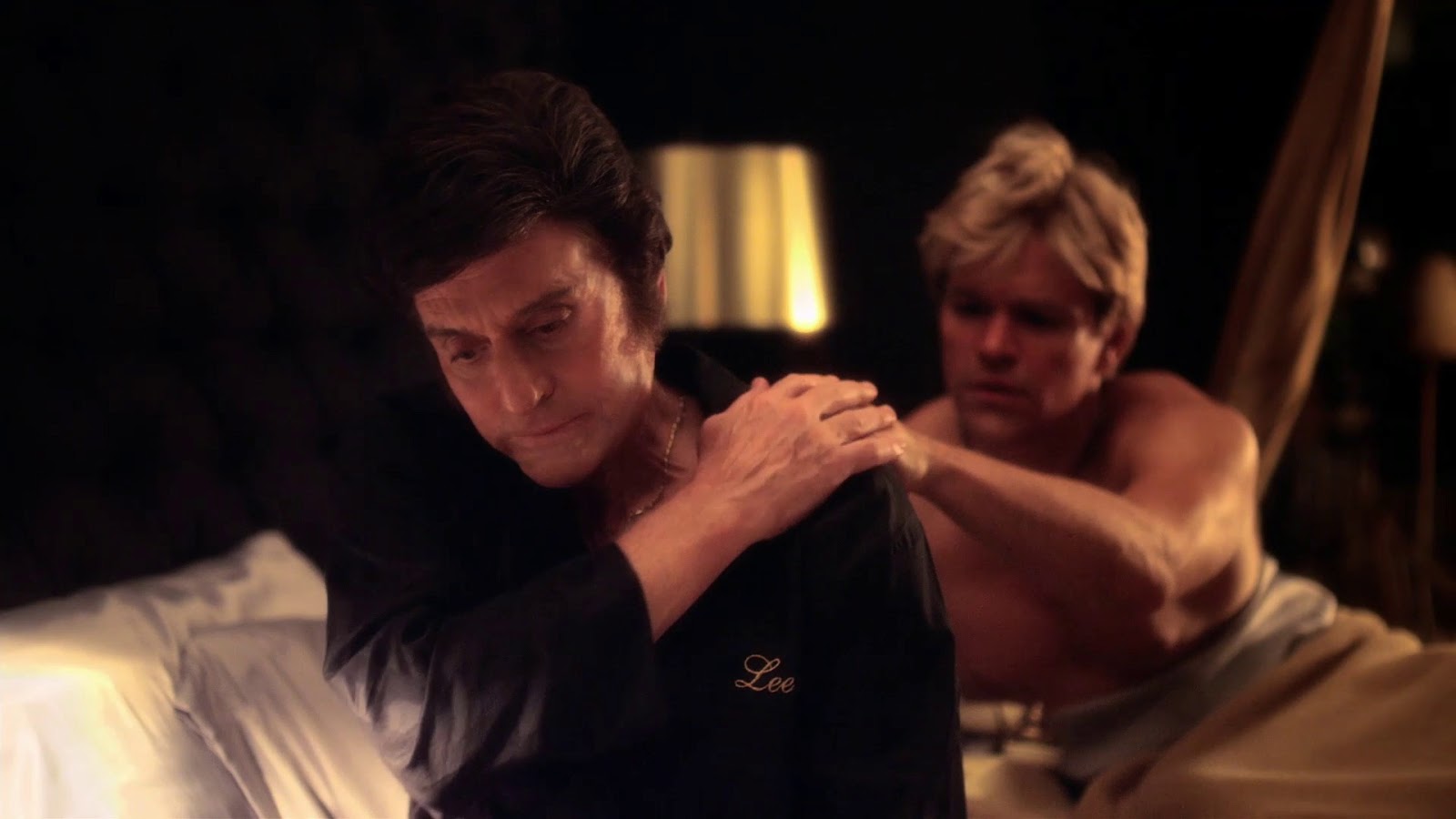
There's a lot to be said about the hype surrounding Behind the Candelabra. Reportedly, this saga of the life of famed, closeted homosexual Liberace as seen through the eyes of his boytoy is to be Steven Soderbergh's last film. The director proclaimed that Hollywood found the project to be "too gay," which is ultimately how it fell into the lap of HBO, where it aired in the USA five days after premiering in competition at the Cannes Film Festival. The movie suffered a number of delays related to star Michael Douglas's bout with cancer, and yet Behind the Candelabra persevered. The fact that it took years for a biopic no one really asked for or seemed to want in the first place to make it to the (television) screen makes its existence even more puzzling.

Why was it necessary to bring the story of Liberace to the screen? The film never gets around to answering that question. It doesn't help that most of the key players–aside from Douglas whose performance is the only remarkable and consistent thing in the film–seem to be sleepwalking through the whole thing. The screenplay, adapted by Richard LaGravenese (who happily brought you the films Freedom Writers and P.S. I Love You) from the memoir of Liberace's young lover Scott Thorson, never rises above a half-cocked marital melodrama. Matt Damon, as Thorson, coasts through the film on autopilot, which is rather unfortunate considering he's given the most time onscreen. There's an especially rough moment at the beginning of the second act, where it looks as though the costume department has shoved a pillow under Damon's shirt to try to show the audience that he had "let himself go."

But it's really the involvement of Soderbergh, who has churned out five films over the past two years (for better or worse), that confounds me. Behind the Candelabra is about the most drab, unnecessary, and mediocre swan song that I can think of. It was by sheer coincidence that I watched Gray's Anatomy, Soderbergh's visually dynamic film adaptation of Spalding Gray's exceptional monologue, just weeks prior to Candelabra. In Gray's Anatomy, Soderbergh crafts several truly breathtaking images on the screen, both during Gray's performance as well as the gorgeous black-and-white talking head interviews with ordinary people discussing their personal ocular history. What we see in Candelabra, however, is a series of awkwardly framed shots (like one where at least two thirds of the screen is taken up by crumpled brown bed sheets in the foreground as Douglas and Damon pillow talk, naked bodies perfectly concealed, in the background) and amateurishly stylized drug sequences.

It would seem useless to bother complaining about the film's sexual prudishness, its embarrassing newspaper-headline exposition about the beginning of AIDS, or the strange comic tone that never quite works (as witnessed in all of Rob Lowe's scenes), since these are just minor oversights in a project as lifeless as this one. Contracts, as it seems, needed to be met, and the rhinestones must have already been paid for... What a curious career you etched out for yourself, Mr. Soderbergh.

With: Matt Damon, Michael Douglas, Dan Aykroyd, Rob Lowe, Debbie Reynolds, Scott Bakula, Nicky Katt, Boyd Holbrook, Paul Reiser, Cheyenne Jackson, Tom Papa, Bruce Ramsay, Mike O'Malley, Jane Morris, Garrett M. Brown

Cannes 2013: Winners

Who would have guessed that the gayest and most sexually explicit recipient of the Palme d'Or would be given by Steven Spielberg? Certainly not me, but that's exactly what transpired at the closing ceremony of the 66th annual Cannes Film Festival two Sundays ago when Spielberg and his jury–which consisted of Daniel Auteuil, actress Vidya Balan, filmmaker Naomi Kawase, Nicole Kidman, Ang Lee, Cristian Mungiu, Lynne Ramsay, and two-time Oscar winner Christoph Waltz–awarded Abdellatif Kechiche's La vie d'Adèle - Chapitre 1 et 2, or as it's known in English territories Blue Is the Warmest Color, the festival's top prize. In a surprising move, the jury also presented the film's two lead actresses, Léa Seydoux and Adèle Exarchopoulos, with the Palme. This left the Best Actress prize to be awarded to another French thespian, Bérénice Bejo, in Asghar Farhadi's Le passé (The Past). Two American films walked away with honors; the Coen Brothers' Inside Llewyn Davis took home the Grand Prix, and Bruce Dern claimed the Best Actor prize for Alexander Payne's Nebraska. Mexican filmmaker Amat Escalante (Los bastardos, Sangre) was named Best Director for the film Heli. Jia Zhang-ke won the Best Screenplay prize for A Touch of Sin, and the jury prize went to Hirokazu Kore-eda's Like Father, Like Son.

It proved to be a rather strong year for queer films at Cannes, with Alain Guiraudie's L'inconnu du lac (Stranger by the Lake) beating the Palme d'Or winner for the Queer Palm award. FIlmmaker João Pedro Rodrigues (To Die Like a Man) was the head of that particular jury. Stranger by the Lake is the fourth film to have won the prize, following Gregg Araki's Kaboom in 2010, Oliver Hermanus' Skoonheid (Beauty) in 2011, and Xavier Dolan's Laurence Anyways in 2012. In addition to the Queer Palm, Alain Guiraudie was named Best Director in the Un Certain Regard section; the top prize went to Rithy Panh's L'image manquante (The Missing Image). The rest of the awards given this year are below.

Palme d'Or: La vie d'Adèle - Chapitre 1 et 2 (Blue Is the Warmest Color), d. Abdellatif Kechiche, France/Belgium/Spain
Grand prix: Inside Llewyn Davis, d. Joel Coen, Ethan Coen, USA/France
Prix du jury: Like Father, Like Son, d. Hirokazu Kore-eda, Japan
Prix de la mise en scène (Best Director): Amat Escalante - Heli
Prix d'interprétation féminine (Best Actress): Bérénice Bejo - Le passé (The Past)
Prix d'interprétation masculine (Best Actor): Bruce Dern - Nebraska
Prix du scénario (Best Screenplay): Jia Zhang-ke - A Touch of Sin

Caméra d'Or: Ilo Ilo, d. Anthony Chen, Singapore

Prix Un Certain Regard: L'image manquante (The Missing Picture), d. Rithy Panh, Cambodia/France
- Prix du jury: Omar, d. Hany Abu-Assad, Palestine
- Prix de la mise en scène: Alain Guiraudie - L'inconnu du lac (Stranger by the Lake)
- Prix Un Talent Certain: The acting ensemble - La jaula de oro
- Prix de l'avenir: Ryan Coogler - Fruitvale Station

FIPRESCI Awards
- Competition: La vie d'Adèle - Chapitre 1 et 2 (Blue Is the Warmest Color), d. Abdellatif Kechiche, France/Belgium/Spain
- Un Certain Regard: Manuscripts Don't Burn, d. Mohammad Rasoulof, Iran
- Quinzaine des Réalisateurs: Blue Ruin, d. Jeremy Saulnier, USA

Semaine de la critique Grand Prix: Salvo, d. Fabio Grassadonia, Antonia Piazza, Italy/France

Queer Palm: L'inconnu du lac (Stranger by the Lake), d. Alain Guiraudie, France

07 May 2013

Poster for Alain Guiraudie's L'inconnu du lac, premiering at Cannes.


With the Cannes Film Festival just a week away, I thought it might be fitting to post this incredible poster for the film I'm probably most excited to see at the festival this year, Alain Guiraudie's L'inconnu du lac (Stranger by the Lake). The film screens as part of the Un Certain Regard section and will be released theatrically in France on 12 June by Les Films du Losange. In years past, I've collected as many posters for the films at the festival as possible, but since then, others–like Adrian Curry with his Movie Poster of the Week–have picked up my slack. Though I won't be doing a poster round-up, I will be posting about Cannes later this week. Until then!

23 April 2013

"Comic Strip"


Gainsbourg: A Heroic Life
Gainsbourg (Vie héroïque)
2010, France
Joann Sfar

That Joann Sfar’s Serge Gainsbourg film was originally planned to star the famed musician’s own daughter, Charlotte Gainsbourg, as her father makes it difficult to imagine that, when Charlotte dropped out, anything or anyone that could have successfully taken her place. Sure, the casting of a woman in the role of an iconic, enigmatic singer/songwriter had been done (successfully) in Todd Haynes’ Bob Dylan pic I’m Not There., with Cate Blanchett, but the possibility of seeing Charlotte Gainsbourg in drag as her late father, seducing and romancing an actor playing her mother, would have been as decidedly pervy and enticing as Charlotte’s own teenage duet with daddy, “Lemon Incest.” So it came as a bit of a surprise (to me, at least) that Gainsbourg (Vie héroïque), sans Charlotte, is actually quite good.

Certainly Eric Elmosnino’s channeling of Monsieur Gainsbourg, which won him the Best Actor prize at the Césars, is impressive, but a solid impersonation does not a good film make. Instead, it’s the bolder choices made by Sfar, best known as a comic artist, in his first foray as a filmmaker that elevate Vie héroïque, which he adapted from his own graphic novel, beyond your factory-line Hollywood biopic. Sfar too won the César for Best First Film. Throughout the film, Serge–whether played as an adult by Elmosnino or as the child Lucien Ginsburg by Kacey Mottet Klein (of Ursula Meier’s Home)–is accompanied by a nightmarish, computer-animated version of himself, which serves as a visually exciting and narratively clever device.

Sfar also excels at one of the film’s more difficult tasks: introducing the many famed women of Gainsbourg’s life. It’s unfortunate that the two women who get the most screen time, Brigitte Bardot and Jane Birkin, are the least convincing performances in the film, despite both Laetitia Casta and Lucy Gordon’s strong physical resemblances to their respective characters. However, each of the women represented in the film enter the film explosively, almost the way I would imagine would befit the introduction of a series of recognized villains in a well-known comic book or video game. Villains these women, of course, are not, but they each provide their own individual challenges to our hero.

 
The more inspired performances come from Yolande Moreau as Fréhel, Sara Forestier as France Gall, Mylène Jampanoï as Bambou, and especially Anna Mouglalis as Juliette Gréco. Greco’s entrance is the most astonishing: a single shot of the opening her eyes to the sound of a thunder clap, as if she were waking from a hundred-year slumber. There’s also a funny, cartoonish cameo from Claude Chabrol (in his final appearance on the silver screen) as the record producer to whom Gainsbourg brings his new version of “Je t’aime, moi non plus” with Birkin filling in on vocals for Bardot. Again, it’s all about the eyes. Vie héroïque is probably the best biopic of Serge Gainsbourg that could have been made without Charlotte, and for that, Sfar should be commended.

With: Eric Elmosnino, Lucy Gordon, Laetitia Casta, Doug Jones, Kacey Mottet Klein, Razvan Vasilescu, Dinara Droukarova, Anna Mouglalis, Mylène Jampanoï, Sara Forestier, Yolande Moreau, Philippe Katerine, Deborah Grall, Ophélia Kolb, Claude Chabrol, François Morel, Joann Sfar